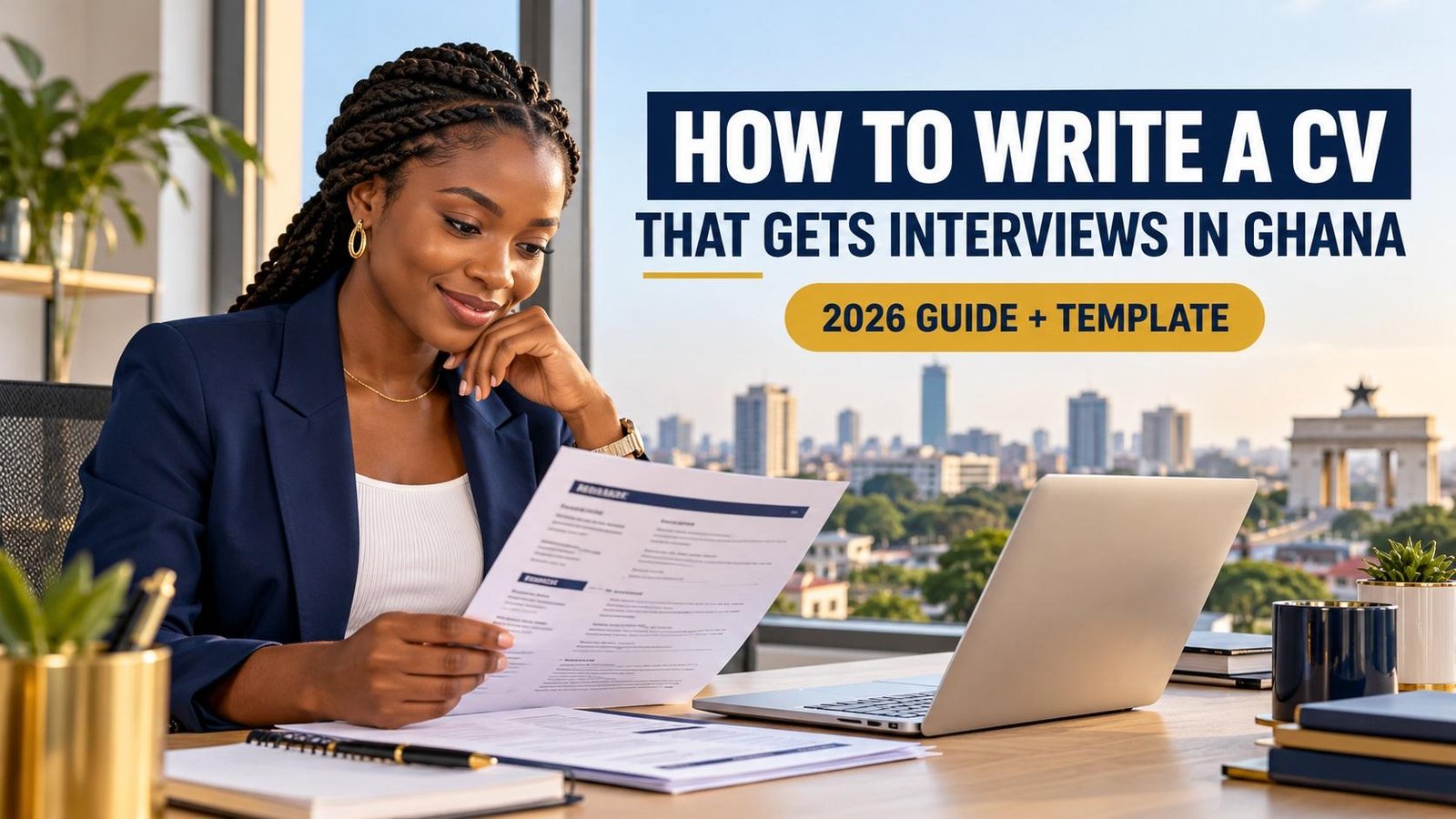
A step-by-step guide to writing a CV that gets interviews in Ghana: structure, what to include, what to leave out, a ready-to-use template and common mistakes to avoid.
Most recruiters in Ghana spend only a short time scanning a CV before deciding whether to read further. In that time, your CV must show three things clearly: who you are, what you can do, and what results you have delivered.
Many graduates and young professionals send CVs that are too long, poorly formatted, full of personal details employers do not need, and short on evidence. This guide shows you how to write a CV that gets interviews, with a simple template you can follow.
CV vs résumé: what Ghanaian employers expect
In Ghana, “CV” is the common term for the document you send with job applications. For most jobs, aim for a concise 1–2 page CV. Longer academic CVs are only expected for lecturing, research and some senior roles.
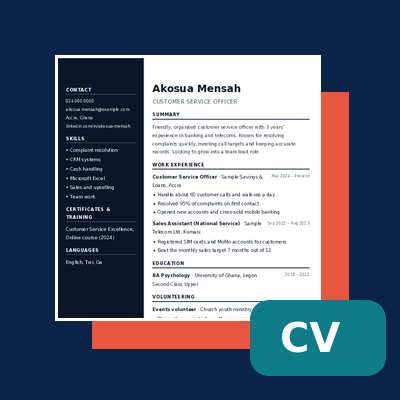 Free CV Builder
Build a job-winning CV in minutes: 12 templates, cover letter, PDF & Word. Free to start.
Build my CV
Advertise here
The ideal CV structure
- Header: full name, phone number, professional email, location (city), LinkedIn URL
- Professional summary: 3–4 lines about who you are and what you offer
- Key skills: 6–10 relevant skills
- Work experience: including internships, national service and attachments
- Education
- Certifications and training
- Leadership, volunteering and projects
- References: “Available on request” or 2 referees if the job advert asks
Step-by-step: writing each section
1. Header: keep it professional
Use a professional email address (for example, firstname.lastname@gmail.com), not a nickname. Include your phone number, city and LinkedIn profile. You do not need your date of birth, religion, marital status, hometown or a photo unless the employer specifically asks.
2. Professional summary: your 10-second pitch
Write 3–4 lines tailored to the job. Example:
Accounting graduate (First Class) with national service experience in a mid-sized audit firm. Skilled in financial reporting, Excel modelling and tax compliance. Supported the audit of 12 client accounts and reduced reconciliation errors through a new tracking sheet. Seeking an entry-level accounting role in a growth-focused organisation.
3. Key skills: match the job advert
Read the job advert carefully and mirror its key skills (where you genuinely have them). Many organisations use applicant tracking systems or quick keyword scans. Mix technical skills (e.g. QuickBooks, Python, data analysis, customer service) with transferable skills (e.g. communication, teamwork, problem-solving).
4. Work experience: show results, not duties
List roles from most recent. For each role, write 3–5 bullet points that start with an action verb and, where possible, include a number or result.
| Weak (duty) | Strong (result) |
|---|---|
| Responsible for social media | Grew the company’s Instagram following from 1,200 to 5,000 in six months through a weekly content plan |
| Handled customer complaints | Resolved an average of 25 customer complaints weekly, maintaining a 90% satisfaction score |
| Did data entry | Digitised 3,000 paper records, cutting file retrieval time from hours to minutes |
National service, internships, attachments, part-time jobs and volunteer roles all count, especially for fresh graduates.
5. Education
Include your degree, institution, years and class (if it is strong). Fresh graduates can add relevant courses, a final-year project or academic awards. Experienced professionals can keep this section short.
6. Certifications and training
Add relevant certificates, for example from professional bodies, Google, Microsoft, Coursera or industry-specific training. Only list what is relevant to the job.
7. Leadership, volunteering and projects
Student leadership, church or community roles, personal projects, a business you started: these show initiative, especially when your work experience is limited. Read 7 skills every student should learn before graduation for ideas on building this section.
8. References
Write “References available on request” unless the advert asks for referees. Always ask permission before listing anyone, and brief them about the job.
Simple CV template
FULL NAME
Accra, Ghana · 024 000 0000 · name@email.com · linkedin.com/in/yournamePROFESSIONAL SUMMARY
3–4 lines: who you are, your key strengths, one achievement, the role you want.KEY SKILLS
Skill · Skill · Skill · Skill · Skill · SkillWORK EXPERIENCE
Job Title, Organisation, City | Month Year – Month Year
• Action verb + task + result (with a number)
• Action verb + task + result
• Action verb + task + resultEDUCATION
Degree, Institution | Year – Year | ClassCERTIFICATIONS
Certificate name, Issuer, YearLEADERSHIP & VOLUNTEERING
Role, Organisation | Year: one line on impactREFERENCES
Available on request
Formatting rules that make a difference
- Use a clean, readable font (e.g. Calibri, Arial, Verdana) at 10–12pt.
- Keep margins consistent and use clear headings.
- Avoid heavy colours, tables and graphics that break when scanned or printed.
- Save and send as PDF, named properly: Firstname-Lastname-CV.pdf.
- Check spelling and grammar twice, then ask someone else to proofread.
Common CV mistakes Ghanaian applicants make
- Including unnecessary personal details (date of birth, religion, marital status, hometown, ID numbers)
- Writing long objectives like “To work in a reputable organisation where I can use my skills…”
- Listing duties instead of achievements
- Sending the same CV for every job
- Using an unprofessional email address
- Exaggerating or inventing qualifications; background checks will expose this
Employers also look beyond your CV. See 5 things employers check before hiring you.
Write a short cover letter or email
When applying by email, write a brief message (4–6 lines) stating the role, where you saw it, one or two reasons you are a strong fit, and that your CV is attached. Use a clear subject line, for example: “Application for Marketing Officer – Ama Mensah.”
Frequently asked questions
How many pages should a CV be in Ghana?
For most jobs, 1–2 pages. Fresh graduates should aim for one strong page; experienced professionals can use two.
Should I put my picture on my CV?
Generally no, unless the employer specifically requests it. Your skills and results should be the focus.
Should I include my national service on my CV?
Yes. National service is valuable work experience. List it like any other job, with results and achievements.
Do I need to include references on my CV?
Only if the job advert asks for them. Otherwise, write “References available on request.”
Your CV is only one part of your professional brand. Your LinkedIn profile, online presence and reputation all speak for you. Learn more in how to build a personal brand on LinkedIn, or get personal help through my Professional Branding service.

Build a powerful professional brand with Isaac Mintah. Strategic LinkedIn optimisation, personal identity development, and reputation building for ambitious pro...


 Become a Forever Business Owner
Buy Forever products at a discount, earn retail profit and get team support. Join my team.
See how it works
Advertise here

About the Author
Isaac Mintah
Entrepreneur, Author & Emotional Intelligence Coach. Founder of Activezoon Universal Limited Company.
Follow on WhatsApp ChannelGrab a Copy
Emotional Intelligence For Career Growth
Isaac Mintah's flagship book — get your copy now from Amazon or Jumia Ghana.
Leave a comment
Your email address will not be published. Required fields are marked *