
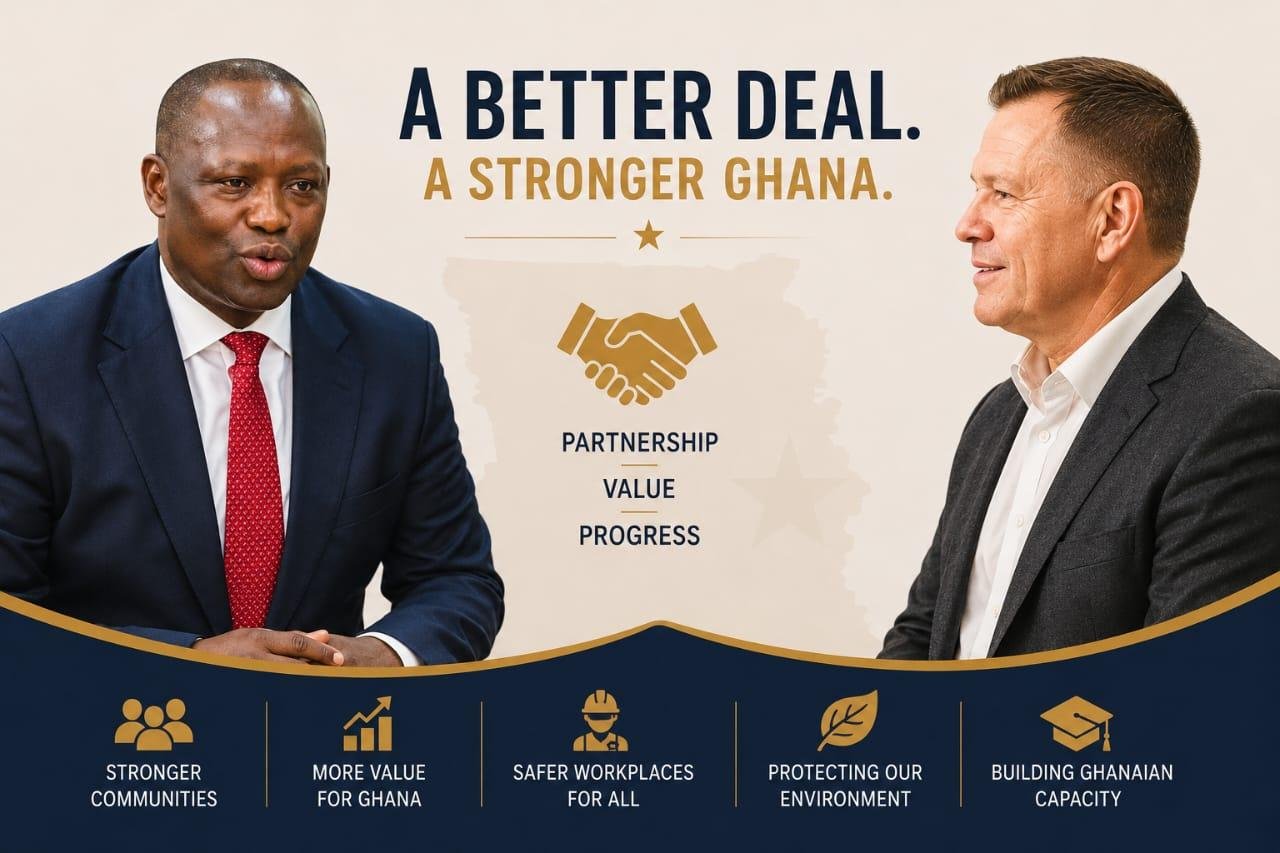
Ghana does not have to choose between foreign expertise and Ghanaian ownership. The smarter path is to retain proven operational capacity while building a stronger model of shared prosperity.
Ghana is approaching a critical decision over the future of the Gold Fields Tarkwa Mine.
Five of Gold Fields' six Tarkwa mining leases, together with its existing Development Agreement, are due to expire in April 2027. Gold Fields Ghana Limited submitted an early application for renewal in November 2025, in line with an agreement reached with the Government of Ghana in April 2025, and in July 2026 followed up with a comprehensive commercial proposal to the Government of Ghana covering future investment, increased value-sharing with Ghana, expanded community investment, greater support for local businesses and further investment in local skills development. Ghana's Minerals Commission has since signalled that renewal will not be automatic: it will require a two-stage technical and ministerial review, with the company expected to demonstrate economic benefits beyond mineral extraction.
The decision comes amid a much larger national conversation about who should own and control Ghana's mineral resources.
The Institute of Economic Affairs (IEA) has opposed renewal on the current basis, arguing that Ghana should prioritise national ownership and control of mineral resources and allow foreign participation through service arrangements where appropriate.
The Apinto Divisional Council, the traditional authority for the Tarkwa area, has similarly called for the Tarkwa operation to be handed to a Ghanaian-owned mining company when the current leases expire, and has developed its own "Apinto Shared Prosperity Proposal" seeking an equity stake for host communities.
At the same time, hundreds of Tarkwa residents demonstrated in late August 2026 under the banner "Gold Fields Must Stay," carrying placards including "Renegotiate GoldFields Deal," "Remember Damang Road" and "Remember Tarkwa Stadium" — and youth groups in the neighbouring Huniso communities have gone further, launching a rival "Gold Fields Must Stay for 20 Years" campaign.
This is therefore not a simple debate between those who love Gold Fields and those who oppose foreign mining companies.
It is a debate about capacity, ownership, revenue, safety, communities, investment and Ghana's long-term national interest.
My position is straightforward:
Ghana should seriously consider renewing Gold Fields' Tarkwa leases—but the renewal should not simply reproduce the old arrangement. It should become the foundation for a new Ghana–Gold Fields–host community shared-prosperity agreement that gives Ghana and its communities substantially more value while creating a deliberate pathway toward greater Ghanaian ownership and operational capability.
Tarkwa Is Too Important to Treat as an Ordinary Ownership Transaction
Tarkwa is one of Africa's major open-pit gold mines and one of Ghana's most important mining assets, producing 537,200 ounces of gold in 2024. The Government of Ghana holds a 10% free-carried interest in the operation under the Minerals and Mining Act, 2006.
Running a mine of this nature requires far more than access to mineral deposits. It requires geological exploration, mine planning, heavy equipment, processing facilities, tailings management, environmental rehabilitation, occupational health and safety, contractor management, emergency response, supply-chain management, community relations, financial risk management, regulatory compliance and long-term capital investment.
That is why the ownership question cannot be separated from the operational question. Who owns the mine matters. But who can safely and sustainably operate it matters just as much.
The decision facing Ghana is not merely about what happens when the current leases expire. It is about how one of Ghana's most important mineral assets will be developed for many years afterward.
Gold Fields Has Invested Heavily in Ghana
Any serious discussion of the lease renewal must acknowledge the scale of Gold Fields' investment and economic contribution.
Gold Fields has operated in Ghana for more than 30 years. Together with the neighbouring Damang mine, it has invested approximately US$5.0 billion in capital since 2000.
It has contributed approximately US$2.9 billion to the Ghanaian fiscus in taxes, royalties and dividends over that period.
These figures do not mean Gold Fields should automatically receive another lease.
They demonstrate something else:
Tarkwa requires an operator capable of deploying substantial capital and managing a technically complex industrial operation.
The Mine Is Bigger Than Gold Fields
The economic impact of Tarkwa cannot be measured by Gold Fields' profits alone.
In 2024, Gold Fields reported 568 employees and 5,092 contractors at Tarkwa, with 71 percent of its people employed from the host community.
Across its wider Ghana operations, the company reports approximately 7,000 Ghanaians employed as direct staff and contractors, with around 70 percent drawn from host communities.
That workforce supports a much larger economic ecosystem. The mine creates demand for transport, engineering, equipment maintenance, security, catering, construction, accommodation, professional services, fuel, logistics, agricultural products, retail businesses and technical services.
Gold Fields reports that host community suppliers account for around 70 percent of its local procurement in Ghana.
That is an important point in the renewal debate.
If the mine changes ownership, the Government must ensure that this economic ecosystem is not weakened.
Tarkwa Residents Are Not Speaking With One Voice
The current debate also demonstrates that host communities cannot be treated as one unified political block.
Some traditional authorities have called for Ghanaian ownership.
The Apinto Divisional Council argued in July 2026 that a recent inspection of the Tarkwa mine area found more than 4,000 hectares of Apinto land degraded. It called for the mine to be handed to a Ghanaian-owned operator, or at minimum for host communities to become equity partners.
Yet other residents have publicly supported the continuation of Gold Fields.
In late August 2026, hundreds of youth, opinion leaders, assembly members and residents marched through Tarkwa carrying placards reading "GoldFields Must Stay," "Renegotiate GoldFields Deal," "Remember Damang Road" and "Remember Tarkwa Stadium."
A separate petition from residents across several host communities argued that support for renewal should not be assumed unanimous either. In Huniso, which its residents say hosts more than 70 percent of the Tarkwa mine, youth and opinion leaders have gone further still — arguing that an untested Ghanaian entity or state vehicle could not be assumed to match the mine's current scale, safety and operational efficiency.
This suggests that the real community demand may be more complicated than simply "Gold Fields must leave." It may instead be: "Whoever operates this mine, the deal must work better for us." That distinction is extremely important.
Gold Fields' Community Investment Is Significant
Through the Gold Fields Ghana Foundation, the company reports having invested more than US$109 million directly into host communities as of August 2026, including the 33-kilometre asphalted Tarkwa–Damang road and the redevelopment of the Tarkwa and Aboso Stadium.
These investments should be recognised. But they should not be the basis for saying that communities have received everything they deserve. Corporate social investment is not a substitute for structural economic participation.
Ghana Should Not Simply Renew the Old Deal
The strongest argument for renewal is not that Gold Fields has done enough. The stronger argument is that Gold Fields has demonstrated substantial operational capability, capital commitment and stakeholder infrastructure — and that Ghana can therefore use the renewal negotiations to demand a fundamentally better economic and social arrangement.
Gold Fields' July 2026 proposal already gestures in this direction, seeking increased value-sharing, expanded community investment, stronger support for local businesses and further skills development. Government should take that proposal seriously — but negotiate aggressively.
Ghana owns the mineral resource. Gold Fields brings capital and operating expertise. Host communities provide the social and geographical environment in which mining occurs. Ghanaian workers provide much of the labour. Ghanaian businesses provide supplies and services. The Government regulates the sector. The next agreement should recognise all of these interests.
A New Ghana–Gold Fields–Host Communities Shared Prosperity Compact
Rather than simply extending the existing arrangement, Ghana should establish a new Tarkwa Shared Prosperity Compact.
Ghana Must Receive More Value
Ghana should negotiate stronger mechanisms for capturing value from the operation while maintaining commercial incentives for continued investment — stronger fiscal participation, production-linked value-sharing, mechanisms tied to exceptionally high gold prices, increased Ghanaian equity participation, greater investment in local skills, and stronger local procurement commitments. Ghana already has a 10% free-carried interest in Tarkwa; the challenge is determining how that participation can be complemented without making the operation commercially unsustainable.
Host Communities Should Have a Structured Economic Interest
Host communities should not depend entirely on corporate goodwill. A new agreement should establish a Tarkwa Community Development and Prosperity Fund with predictable contributions and independent governance, along the lines the Apinto Divisional Council itself is now proposing.
Gold Fields Must Remain Commercially Sustainable
Shared prosperity should not mean destroying the commercial incentive to invest. The goal should not be that Ghana wins and Gold Fields loses; it should be that Ghana wins more, communities win more, Ghanaian businesses win more, workers are safer, the environment is protected — and Gold Fields remains commercially motivated to invest.
Ghanaian Ownership Should Be the Destination — Not Necessarily an Immediate Transfer
Ghanaian ownership of Ghana's mineral resources is a legitimate and desirable national objective.
But Ghanaian ownership and Ghanaian operational capability are not the same thing.
A Ghanaian-owned company may still need to build large-scale mine-planning experience, geological expertise, access to international financing, equipment-management systems, tailings expertise, environmental-management capacity, large-scale contractor-management experience and mature occupational-health-and-safety systems.
Ghana should build Ghanaian mining champions.
But it should build them deliberately.
The Damang Transition Should Be Studied Closely
Ghana has already created an important case study through the transition of Gold Fields' neighbouring Damang Mine.
But the real sequence of events is more complicated than the tidy version sometimes told.
Damang's roughly 30-year mining lease, held through Gold Fields' Ghanaian subsidiary Abosso Goldfields Limited, expired on 18 April 2025.
Ghana's Minerals Commission declined Gold Fields' application for a further extension.
Rather than an abrupt closure, the Government and Gold Fields agreed a non-renewable 12-month transitional mining lease, ratified by Parliament in mid-2025, to allow an orderly handover. Mining activity restarted in May 2025.
Gold Fields completed and submitted a feasibility study to the Minerals Commission in December 2025. It found that the mine could sustain roughly nine further years of production at 100,000–150,000 ounces annually, with an estimated US$600 million in further capital investment.
In March 2026 the Government launched a competitive tender for a new operator, restricted to Ghanaian-owned companies and setting a minimum financing threshold of US$500 million.
Four companies bid. Two met the mandatory requirements.
On 7 April 2026, the Minerals Commission's Tender Committee recommended Engineers and Planners Limited (E&P) as the successful bidder — Damang's mining contractor of some 25 years, which demonstrated access to US$505 million in financing.
E&P formally assumed control at a handover ceremony on 18 April 2026. President John Dramani Mahama personally instructed that no jobs be lost among Damang's workforce of more than 2,000.
The mine now operates under the name Damang Gold Mine Ltd, with Ibrahim Mahama as chief executive. In May 2026, the company sold 100 percent of its first gold output — around 110 kilogrammes — to the Ghana Gold Board, a move the Board's CEO, Sammy Gyamfi, called a wake-up call for large-scale miners to contribute more directly to the country's reserves.
Two things are worth stating plainly here, because they refine the narrative.
First, Ghana did not take Damang into state operation. It ran a tender restricted to Ghanaian-owned bidders and awarded a lease to a private company with two and a half decades of hands-on experience at the site — a different, and arguably more evidence-based, model than either "renew the foreign lease" or "nationalise the mine."
Second, E&P's chief executive, Ibrahim Mahama, is the brother of President Mahama.
Multiple outlets noted this when reporting the handover. It does not by itself mean the tender was improperly conducted — E&P's decades as contractor and its demonstrated financing are real, verifiable qualifications. But an article arguing for evidence over symbolism has to disclose it rather than leave it out.
This creates an extraordinary, if imperfect, opportunity for Ghana to learn.
Before implementing a much larger transition at Tarkwa, Government should track Damang's production, costs, safety, employment, contractor management, supplier relationships, environmental management, capital expenditure, government revenue and community relations under its new operator — and should be transparent about doing so, including about the governance safeguards in place given the ownership structure involved.
Policy should be driven by evidence, not symbolism.
That is exactly why the details of how Damang's operator was selected matter as much as the headline fact that it is now Ghanaian-owned.
Build Ghanaian Ownership Through a Gradual Transition
There is a middle path between permanent foreign ownership and immediate transfer. Gold Fields could remain the technical operator at Tarkwa while Ghanaian investors — institutional investors, pension funds, the Minerals Income Investment Fund, mining-investment companies, qualified private investors and host-community investment vehicles — progressively increase their ownership.
Phase One: Continued Gold Fields Operation
Gold Fields retains operational responsibility while Ghana increases its economic participation.
Phase Two: Ghanaian Equity Expansion
Qualified Ghanaian investors progressively acquire a larger stake.
Phase Three: Skills Transfer
Ghanaian engineers, geologists, managers and technical professionals progressively occupy senior positions.
Phase Four: Supplier Industrialisation
Ghanaian businesses move from being contractors and suppliers into larger engineering, technology and operational roles.
Phase Five: Increased Ghanaian Operational Responsibility
Once Ghanaian partners demonstrate sufficient technical, financial and safety capability — the same kind of capability E&P had to demonstrate to win the Damang tender — greater operational responsibility can be transferred.
Mining Is About More Than Extracting Gold
Mining is often reduced to three questions: who owns the mine, how much gold it produces, and how much money Government receives. Those questions matter, but they are not enough. A successful mine must protect employees, contractors, suppliers, communities, visitors and emergency responders, and the surrounding ecosystem, while maintaining safe workplaces, environmental controls, tailings facilities, emergency systems and supply-chain resilience. Safety and welfare are not side issues in mining. They are fundamental to sustaining the operation itself.
Gold Fields Is Not Perfect on Safety
A credible argument for renewal must acknowledge Gold Fields' own shortcomings. In 2023, the company recorded contractor fatalities at Tarkwa, including one connected to the reconstruction of the Foundation-funded Tarkwa and Abosso Stadium, and initiated an independent review of its safety culture, processes and systems. No serious analysis should portray Gold Fields as an organisation that has eliminated mining risk. It has not.
Subsequent performance also matters. Group-wide, Gold Fields reports that its Safety Improvement Plan, launched in 2024, resulted in no fatalities across any of its operations in 2025, alongside seven serious injuries recorded that year. The appropriate conclusion is not that Gold Fields is perfect, but that the company has demonstrated an ability to invest in safety systems, investigate failures and improve performance — the kind of institutional capability Ghana must preserve while demanding continuous improvement, including transparent, contractor-inclusive reporting specific to Tarkwa itself.
The Wider Ghanaian Mining Industry Shows Why Safety Matters
The Ghana Chamber of Mines reported that serious injuries across the industry rose sharply from 17 in 2023 to 43 in 2024, even as fatal incidents fell from seven to four over the same period. The following year brought further improvement: three industry-wide fatalities in 2025, down from four in 2024, alongside 34 serious injuries — though the Chamber's chief executive stressed that "three deaths are too many" and that the industry's goal remains zero fatalities and zero harm. Mining safety cannot be assumed simply because an operator is large, foreign, local or experienced.
Ghana Has Also Seen Serious Mining-Related Community Conflicts
Mining safety extends beyond the pit. Several serious incidents across Ghana's wider mining sector illustrate the risks — included here not as findings against any individual company, but to show the operating environment large-scale mining sits within.
The Tontokrom–Asanko Incident
On 2 March 2024, a confrontation between residents of Manso Tontokrom and private security personnel guarding Asanko Gold Mines' concession resulted in three deaths: a resident was allegedly shot by security personnel, after which two members of the private security team were killed by residents in a reprisal attack. This should not be read as proof that Asanko caused all three deaths or is inherently unsafe — it arose from a longer-running land and boundary dispute — but it underlines that community relations and mine security can become matters of life and death.
The Obuasi Incident
On the night of 18–19 January 2025, a confrontation at AngloGold Ashanti's Obuasi mine between soldiers and a group the military said comprised around sixty armed illegal miners resulted in disputed casualty figures: the Ghana Armed Forces said seven illegal miners were killed in a firefight; the Ghana National Association of Small-Scale Miners said nine unarmed people were killed and fourteen injured. President Mahama ordered an investigation. Both figures are presented here rather than treated as settled, given the genuine dispute between the two accounts.
The Gbane Incident
On 15 March 2024, a roughly seven-hour confrontation between Ghana's Upper East Regional Security Council and illegal miners at Gbane, on a concession leased to Earl International Group Ghana Gold Limited, resulted in reported deaths whose exact number varies by source — one or two, depending on the account — alongside injuries. Earl International cited the intrusion of illegal miners, including tunnels dug toward its concession, as a central operational challenge.
These Incidents Should Not Be Used to Attack Other Companies
It would be unfair to conclude from individual incidents that AngloGold Ashanti, Asanko or Earl International are inherently unsafe companies. Some incidents involved illegal miners, community protests, private or state security, and disputed accounts. They show that the operating environment around a large mine can be extraordinarily complex, and that a capable mining company needs systems for managing people, safety, security, communities, contractors, government relations and the environment together.
Contractor Safety Must Be Part of the Renewal
Contractors perform major portions of mining work and can be exposed to significant operational risks; Gold Fields' own 2023 Tarkwa fatalities involved contractors. The new Tarkwa agreement should require transparent reporting covering employee fatalities, contractor fatalities, serious injuries, high-potential incidents, emergency response and contractor training. Everyone working on the mine should count.
Environmental Stewardship Must Be Part of the Agreement
A mine has long-term responsibilities for land, water, tailings, biodiversity, waste, rehabilitation and closure. A renewed lease should require independently verified environmental performance, transparent water-quality monitoring, progressive land rehabilitation, tailings-management audits, biodiversity protection and adequately funded mine closure — obligations that should remain binding regardless of who owns the mine.
Ghanaian Suppliers Should Become Industrial Champions
Ghana should ask why Ghanaian companies should remain suppliers forever, rather than building toward mining-equipment manufacturing, engineering, logistics, technology, environmental consultancy, safety specialisation and mine-maintenance capability. The real prize is not only the gold beneath Tarkwa. It is the Ghanaian industrial ecosystem that can be built around the mine.
Gold Fields Should Transfer Knowledge, Not Just Pay Taxes
A renewed agreement should contain measurable knowledge-transfer obligations spanning mining engineering, geology, metallurgy, environmental science, safety, mine planning, automation and mine finance, turning Gold Fields' existing institutional partnerships into a structured national mining-capacity initiative.
Ghanaian Ownership Should Be Measured by Capability
Eventually, Ghana should be able to say a mine is Ghanaian-owned and Ghanaian-operated in a way that means more than the nationality of the shareholders: the engineers, the geologists, the capital, the safety systems, the financing and the institutional governance all in place. Until that capability exists at scale, a phased transition is more prudent than an abrupt transfer — precisely the model Damang has now tested, imperfectly, for the first time.
Ghana Should Not Gamble With Tarkwa
If a new operator performs poorly, the consequences could include falling production, declining revenue, job losses, safety incidents and community conflict. National ownership is important. But national capacity is indispensable.
Ghana Can Build Ownership Without Immediately Changing the Operator
Ghana could increase ownership while retaining Gold Fields as the technical operator: Ghanaian institutional investors acquire additional equity, host communities acquire a structured economic interest, Ghanaian professionals progressively assume senior positions, and a measurable transition plan prepares local operators for greater responsibility.
The Government Should Learn From Damang Before Making a Bigger Transition
Government should publish periodic performance assessments of Damang under E&P's operation: production, costs, safety, employment, procurement, environmental management and revenue.
It should also report transparently on the governance safeguards accompanying the award, given the relationship between the operator's chief executive and the President.
Damang can become Ghana's laboratory for responsible mining ownership transition.
Tarkwa should not be the laboratory.
The New Tarkwa Agreement Should Have Measurable Conditions
Safety
A zero-fatality objective, contractors included in all measurements, independent audits, strict emergency-response standards.
Government Revenue
Transparent reporting of taxes, royalties, dividends and value-sharing mechanisms.
Host Communities
A legally structured community-development mechanism with predictable funding.
Local Businesses
Measurable Ghanaian- and host-community-procurement targets and supplier-development financing.
Skills Transfer
Measurable Ghanaian professional-development, apprenticeship and management-succession programmes.
Environment
Progressive rehabilitation, water monitoring, tailings audits, biodiversity protection, funded mine closure.
Ghanaian Ownership
A credible pathway to greater Ghanaian equity and, eventually, operational responsibility.
Ghana Must Negotiate From Strength
Ghana owns the mineral resource. Gold Fields provides capital, technology and operational experience. Host communities provide the environment in which the mine operates. Ghanaian workers provide labour and expertise. The correct relationship is not Ghana versus Gold Fields — it is Ghana and Gold Fields negotiating a better Ghanaian deal.
Renegotiation Is Not Weakness
A lease renewal can be a renegotiation of the economic relationship, not a surrender. Gold Fields has itself indicated that its 2026 proposal is designed to increase value-sharing in Ghana. Government should assess it carefully and negotiate the strongest possible agreement.
Ghana Also Needs Investor Confidence
Ghana's own Chamber of Mines has warned that lease-renewal uncertainty risks creating the impression that security of tenure is not guaranteed, which could raise the risk premium investors attach to the jurisdiction. Ghana can demand better terms without becoming unpredictable — those objectives are not contradictory.
The Case for Renewal Is Not a Case Against Ghanaian Ownership
Supporting renewal does not mean opposing Ghanaian ownership; it means arguing that ownership should be built on demonstrated capability rather than political urgency. Gold Fields can help build that capability while Ghanaian investors, communities and Government capture more of the value in the meantime.
The Gold Fields Debate Is Really a Debate About Ghana's Future
The Tarkwa question should not become a simplistic contest between:
"Gold Fields must stay."
and
"Foreign miners must go."
Both positions are too simplistic.
The real question is:
What mining model will leave Ghana stronger when the gold is gone?
If the answer is a model that combines foreign expertise, Ghanaian ownership, strong regulation, community participation, local industrialisation, environmental protection and world-class safety, then that is the model Ghana should pursue.
Recommendation: Renew, Renegotiate and Build Toward Ghanaian Ownership
The Government of Ghana should seriously consider renewing Gold Fields' Tarkwa leases, subject to comprehensive due diligence — but should not simply renew the existing arrangement. The renewal should establish a new Ghana–Gold Fields–Host Communities Shared Prosperity Compact: more revenue for Ghana, more participation for host communities, more opportunities for Ghanaian businesses, more ownership, more skills transfer, more safety and environmental accountability — while Gold Fields retains enough commercial incentive to keep investing and operating safely.
The Ultimate Test
The real measure of Ghanaian mining policy should not simply be:
"Who owns the mine?"
It should be:
"What does Ghana receive from the mine?"
And even that is not enough.
We should ask:
How many Ghanaian engineers were trained?
How many Ghanaian companies became internationally competitive?
How many host communities became economically stronger?
How many workers returned home safely every day?
How much land was rehabilitated?
How much water was protected?
How much wealth remained in Ghana?
What industries will survive after Tarkwa eventually closes?
That is the standard Ghana should demand.
Conclusion: Do Not Simply Change the Owner — Change the Deal
Ghana has every right to seek greater ownership of its mineral resources. But large-scale mining is a highly specialised activity where mistakes cost lives, jobs, revenue and the environment. Gold Fields is not perfect — it experienced serious safety failures, including contractor fatalities at Tarkwa in 2023 — but its parent company reports no fatalities group-wide in 2025. Serious incidents elsewhere in Ghana's mining sector, at Tontokrom, Gbane and Obuasi, show why mining cannot be reduced to who holds the concession — and Ghana's own Damang experience shows a Ghanaian company can be built to run one, provided the process that selects it is genuinely evidence-based and transparent.
Renew the lease. Renegotiate the deal. Increase Ghanaian participation. Strengthen community benefits. Demand world-class safety. Build local industrial capacity. Transfer knowledge. And prepare Ghanaian investors to take greater ownership when the necessary capability is ready. That is not surrender. That is strategy.
References & Sources
- Gold Fields Limited, SEC Form 6-K, 22 June 2026 (Tarkwa renewal timeline) — https://www.stocktitan.net/sec-filings/GFI/6-k-gold-fields-ltd-current-report-foreign-issuer-51344152dee8.html
- Graphic Online, "Gold Fields defends Tarkwa lease renewal bid," 28 July 2026 — https://www.graphic.com.gh/business/business-news/gold-fields-defends-tarkwa-lease-renewal-bid.html
- MyJoyOnline, "IEA opposes renewal of Gold Fields Tarkwa mining lease," 13 May 2026 — https://www.myjoyonline.com/iea-opposes-renewal-of-gold-fields-tarkwa-mining-lease-calls-for-greater-ghanaian-ownership/
- Ghanaian Times, "Don't renew Gold Fields' Tarkwa lease — Apinto Divisional Council urges govt," 26 July 2026 — https://ghanaiantimes.com.gh/dont-renew-gold-fields-tarkwa-lease-apinto-divisional-council-urges-govt/
- The Ghanaian Chronicle, "Tarkwa Residents Demonstrate For Goldfields' Lease Renewal," c. 27 August 2026 — https://thechronicle.com.gh/tarkwa-residents-demonstrate-for-goldfields-lease-renewal/
- Graphic Online, "Gold Fields to hand over Damang Mine to Ghana in April 2026," 20 February 2026 — https://www.graphic.com.gh/news/general-news/gold-fields-to-hand-over-damang-mine-to-ghana-in-april-2026.html
- Citi Newsroom, "Gov't approves E&P as successful bidder for Damang Mine lease," 7 April 2026 — https://citinewsroom.com/2026/04/govt-approves-ep-as-successful-bidder-for-damang-mine-lease/
- Graphic Online, "Damang Gold Mine sells 100% first gold output to GoldBod," 4 May 2026 — https://www.graphic.com.gh/news/general-news/ghana-news-damang-gold-mine-sells-100-first-gold-output-to-goldbod.html
- Semafor, "Ghana hands major gold mine to local operator," 8 April 2026 (Mahama family relationship) — https://www.semafor.com/article/04/08/2026/ghana-hands-major-gold-mine-to-local-operator
- Reuters, via Mining Weekly, "At least seven people killed by army at Ghana's AngloGold Ashanti mine," 20 January 2025 — https://www.miningweekly.com/article/at-least-seven-people-killed-by-army-at-ghanas-anglogold-ashanti-mine-2025-01-20
- Citi Newsroom, "Three dead in clash between Tontokrom residents and Asanko Mines Security," 2 March 2024 — https://citinewsroom.com/2024/03/three-dead-in-clash-between-tontokrom-residents-and-asanko-mines-security/
- Citi Newsroom, "Chamber of Mines urges firms to actively involve host communities in safety issues," 30 October 2025 — https://citinewsroom.com/2025/10/chamber-of-mines-urges-firms-to-actively-involve-host-communities-in-safety-issues/

About the Author
Isaac Mintah
Entrepreneur, Author & Emotional Intelligence Coach. Founder of Activezoon Universal Limited Company.
Grab a Copy
Emotional Intelligence For Career Growth
Isaac Mintah's flagship book — get your copy now from Amazon or Jumia Ghana.
Leave a comment
Your email address will not be published. Required fields are marked *