
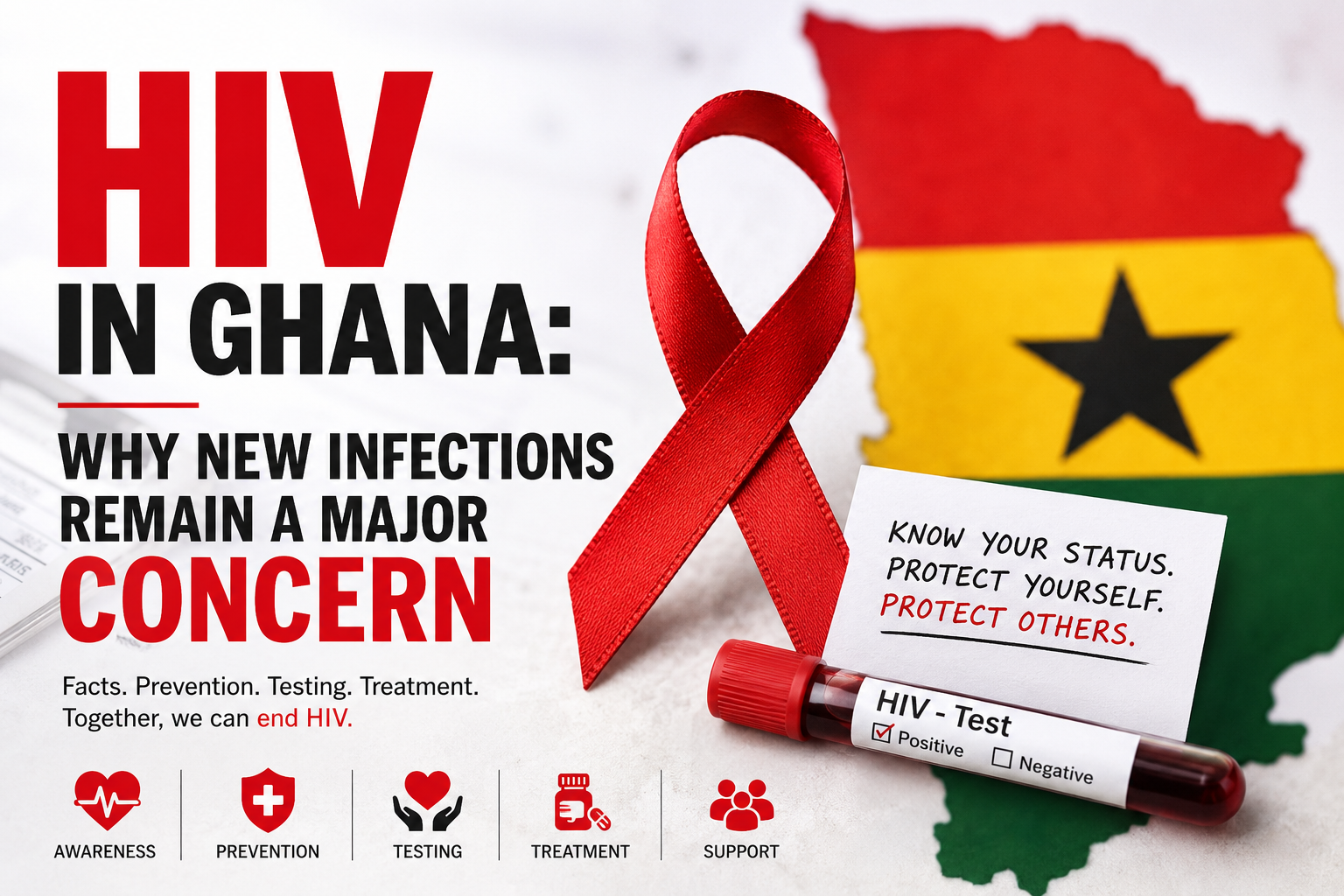
HIV remains one of Ghana’s important public-health challenges—not because infections are currently rising, but because thousands of new infections still occur every year. The latest national estimates show encouraging progress, yet they also reveal why prevention, testing, treatment and education cannot be treated as yesterday’s problems.
Ghana recorded an estimated 13,951 new HIV infections in 2025, down from 16,189 in 2024 according to the latest National HIV Estimates and Projections. About 337,435 people were living with HIV in Ghana in 2025.
So the more important question is not simply “Why is HIV growing in Ghana?” It is:
Why does HIV continue to spread in Ghana despite decades of awareness campaigns, improved treatment and greater access to prevention services?
The Numbers Tell Two Different Stories
Ghana's HIV story is one of both progress and concern.
On one hand, new infections have declined significantly. The latest estimates put new infections at 13,951 in 2025, compared with 15,290 in 2024 and 16,189 in the figures used for the previous year's estimates. Adult HIV prevalence among people aged 15–49 has also fallen from 1.79% in 2015 to an estimated 1.40% in 2025.
On the other hand, 13,951 new infections still means roughly 38 new infections every day.
That is why celebrating the decline must not become an excuse for complacency.
The Ghana AIDS Commission says prevention remains central to Ghana's HIV response, while expanded testing, treatment and care have contributed to the progress recorded so far.
1. HIV Awareness Does Not Always Translate Into Behaviour Change
Ghana has conducted HIV education campaigns for decades. Most people have heard of HIV, know that it can be sexually transmitted and understand that condoms can reduce transmission.
But knowledge and behaviour are not the same thing.
A person can know the risks and still make decisions that increase their exposure. Alcohol and substance use, pressure from partners, relationship dynamics, perceptions of trust and inconsistent condom use can all influence sexual decisions.
This is one reason HIV prevention cannot depend exclusively on posters, radio advertisements or occasional awareness campaigns.
People need practical, continuous and age-appropriate sexual-health education that helps them make informed decisions in real-life situations.
2. Young People Remain an Important Part of the Picture
One of the most concerning aspects of Ghana's HIV situation is the impact on young people.
According to the Ghana AIDS Commission's latest figures, young people aged 15–24 accounted for 27.5% of new HIV infections in 2025.
This deserves serious attention.
Young adulthood is often a period of experimentation, new relationships, increased independence and limited access to reliable health information. Some young people may also avoid HIV testing because of fear, embarrassment or concerns about confidentiality.
The answer is not to shame young people.
It is to make accurate information, confidential testing, condoms, PrEP and other prevention services easier to access while creating environments where young people can ask difficult questions without being ridiculed.
3. Women Continue to Carry a Disproportionate Burden
Another major feature of Ghana's epidemic is the disproportionate impact on women.
In 2025, women represented approximately 65.7% of people living with HIV in Ghana.
This is more than a statistic. It raises questions about relationships, economic vulnerability, access to healthcare, negotiating condom use and the ability of women to make independent decisions about their sexual health.
HIV prevention therefore needs to be connected to broader conversations about women's empowerment, reproductive health, relationship safety and access to healthcare.
Women should not be expected to carry the entire responsibility for preventing HIV. HIV prevention is a shared responsibility between individuals, partners, communities and institutions.
4. Stigma Still Keeps People Away From Testing
One of the most damaging aspects of HIV is not the virus itself—it is the stigma surrounding it.
People may fear being labelled, rejected by partners, exposed to family members or treated differently at work or in their communities.
When people are afraid to test, they may not know their status.
When people do not know their status, they may unknowingly transmit HIV to others.
And when people who test positive fear discrimination, they may delay seeking treatment.
The Ghana AIDS Commission identifies stigma and discrimination among the continuing challenges facing Ghana's HIV response.
This is why HIV education must include a second message:
Knowing your HIV status should not be a source of shame.
5. Some People Still Do Not Know Their HIV Status
Testing remains one of the most powerful tools in the fight against HIV.
A person who knows their status can make informed decisions, access treatment where necessary and take steps to protect their health and their partner.
Modern HIV services also mean that testing does not necessarily require the experience many people imagine. Ghana has expanded prevention approaches, including community-based services, self-testing and PrEP access.
Yet reaching people who have never tested—or who test infrequently—remains important.
Normalising HIV testing as part of routine healthcare could make a significant difference.
6. HIV Is No Longer the Death Sentence Many People Think It Is
Another important part of the conversation is treatment.
HIV treatment has changed dramatically.
With effective antiretroviral therapy and proper medical care, people living with HIV can live long and healthy lives. Treatment also plays an important role in preventing transmission.
Ghana's recent progress has been associated with increased access to antiretroviral medicines, earlier treatment initiation and improved retention of people in HIV care.
This means the conversation should move beyond fear.
The goal should be prevention, early diagnosis, treatment and dignity.
7. Key Populations Need Evidence-Based Prevention
HIV does not affect every population equally.
Ghana's 2026–2028 National HIV Prevention Roadmap reports substantially higher HIV prevalence among several key populations, including female sex workers, people who use drugs, men who have sex with men and transgender people.
These differences matter because prevention programmes must reach people according to their actual circumstances.
Public-health policy should be based on evidence rather than stereotypes.
People who are at higher risk need access to testing, condoms, PrEP, treatment, counselling and other appropriate services without discrimination.
8. The Biggest Danger Is Complacency
Perhaps the greatest mistake Ghana could make is assuming that HIV is no longer a serious issue because the numbers are improving.
The opposite lesson should be learned.
The decline proves that prevention and treatment programmes can work.
The challenge is to sustain and expand what is working.
Ghana's latest estimates project that new infections could fall to about 6,430 by 2030 if prevention programmes, testing services and treatment coverage continue to improve.
That target will require more than government alone.
Schools, universities, religious organisations, employers, healthcare providers, parents, community leaders, media organisations and individuals all have roles to play.
What Can Ghana Do Differently?
If Ghana wants to accelerate the decline in HIV infections, several areas deserve continued attention:
1. Make HIV testing normal.
Testing should be presented as responsible healthcare rather than an admission of risky behaviour.
2. Strengthen youth-focused education.
Young people need accurate information about HIV transmission, prevention, testing and treatment.
3. Expand access to prevention.
Condoms, PrEP, HIV self-testing and other evidence-based prevention options should remain accessible to people who need them.
4. Fight stigma aggressively.
A person living with HIV is still a person deserving dignity, employment, relationships, healthcare and respect.
5. Keep women at the centre of prevention strategies.
The disproportionate burden among women means prevention programmes must address the social and economic realities affecting women.
6. Encourage early treatment.
People who test positive should be connected quickly to appropriate medical care and supported to remain in treatment.
7. Use data rather than assumptions.
Different communities experience HIV differently. Prevention strategies should therefore be guided by evidence.
HIV Prevention Starts With Personal Responsibility
Government programmes are important, but individuals also have responsibilities.
Know your HIV status.
Understand how HIV is transmitted.
Use condoms correctly and consistently when appropriate.
Talk honestly with sexual partners about testing and sexual health.
Seek professional healthcare advice about HIV prevention options such as PrEP when relevant.
And if you test positive, remember that a diagnosis is not the end of your life. Seek medical care and follow your treatment plan.
Most importantly, do not stigmatise another person because of their HIV status.
Ghana Is Making Progress—But the Work Is Not Finished
The latest HIV figures give Ghana a reason for cautious optimism.
New infections are declining. Adult prevalence is declining. AIDS-related deaths also declined in 2025, from 13,429 in 2024 to 12,051.
But thousands of new infections in a single year remain unacceptable if Ghana wants to end AIDS as a public-health threat.
The conversation therefore should not be based on panic.
Nor should it be based on complacency.
It should be based on education, evidence, prevention, testing, treatment and compassion.
The fight against HIV is not simply a fight against a virus. It is also a fight against misinformation, stigma, silence and the belief that the problem belongs to someone else.
Ghana has made progress. Now the challenge is to make that progress permanent—and accelerate it.
A Final Message
HIV prevention is not about judging people's private lives.
It is about protecting human lives.
Whether you are young or old, married or single, sexually active or not, everyone benefits from accurate health information.
Know. Test. Prevent. Treat. Support.
That is how Ghana can move from reducing HIV infections to ultimately ending AIDS as a public-health threat.
This article is intended for public education and should not replace professional medical advice. For HIV testing, prevention, treatment or questions about your individual situation, consult a qualified healthcare professional or an authorised HIV service provider.
Sources: Ghana AIDS Commission, Ghana News Agency, UNAIDS and World Health Organization.

About the Author
Isaac Mintah
Entrepreneur, Author & Emotional Intelligence Coach. Founder of Activezoon Universal Limited Company.
Grab a Copy
Emotional Intelligence For Career Growth
Isaac Mintah's flagship book — get your copy now from Amazon or Jumia Ghana.
Leave a comment
Your email address will not be published. Required fields are marked *