
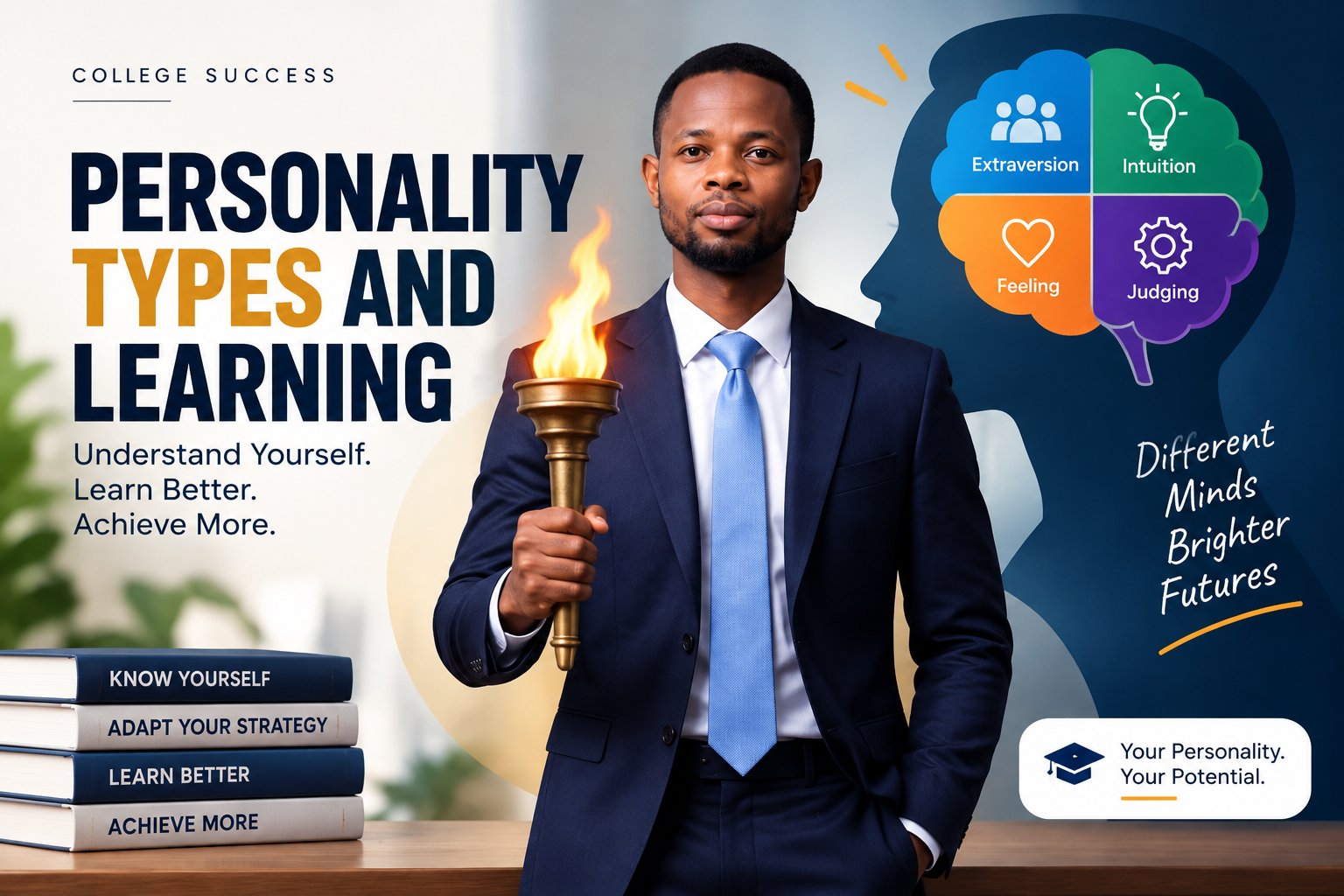
Personality Types and Learning: How Understanding Yourself Can Help You Learn Better
Your personality can influence how you approach studying, solve problems, communicate, and respond to different learning environments. Some students enjoy group discussions, while others prefer studying alone. Some like clear plans, while others prefer flexibility.
Understanding these preferences can help you make better learning decisions. However, personality should not limit how you learn. OpenStax explains that personality frameworks can be useful for self-awareness, but students should remain flexible in their learning approaches. :contentReference[oaicite:0]{index=0}
What Is the Connection Between Personality and Learning?
Personality describes patterns in how people think, interact, make decisions, and respond to their environment. These preferences can influence what students naturally enjoy when learning.
For example, one student may enjoy discussing a topic with classmates, while another may prefer reading quietly and reflecting before sharing an opinion.
The important point is that preference is not the same as ability. A student who prefers studying alone can still become an effective group learner.
Understanding the Myers-Briggs Personality Preferences
The Myers-Briggs framework identifies four pairs of preferences. These preferences are combined to create different personality profiles. :contentReference[oaicite:1]{index=1}
Extraversion (E) and Introversion (I)
Extraverted preferences are generally associated with greater interest in external experiences and social interaction. Introverted preferences tend to focus more on internal thoughts, interests, and reflection.
In education, an extraverted student may enjoy discussions and collaborative activities, while an introverted student may prefer independent study.
Intuition (N) and Sensing (S)
Intuitive preferences tend to focus on broader ideas, possibilities, and connections. Sensing preferences place greater emphasis on facts, details, and direct observation.
A student studying history, for example, might enjoy understanding broad patterns and motivations, while another may prefer working directly with dates, evidence, and specific facts.
Feeling (F) and Thinking (T)
Feeling preferences emphasize values, emotions, and empathy when making decisions. Thinking preferences place greater emphasis on logic, analysis, and reason.
Both approaches can be valuable in academic work.
Judging (J) and Perceiving (P)
Judging preferences tend to favor structure, planning, and organization. Perceiving preferences may be more comfortable with flexibility and adapting as circumstances change.
A student who likes creating a study timetable may prefer structure, while another may work better with a flexible study plan.
Should Your Personality Determine How You Study?
No.
Personality tests can provide useful insights, but they should not place students into permanent categories. OpenStax notes that people can receive different results from personality tests at different times. :contentReference[oaicite:2]{index=2}
Instead, personality information should be used as a tool for self-awareness and experimentation.
Choose Your Learning Strategy Based on the Task
The best learning method can depend on what you are trying to accomplish.
- Writing an essay: Quiet reflection and independent research may be useful.
- Preparing for a presentation: Practicing with other people can improve confidence.
- Studying science: Facts, evidence, practical exercises, and problem-solving can all be useful.
- Preparing for a debate: Discussion, analysis, and understanding different perspectives may be important.
This means effective students need to be adaptable learners.
Use Your Strengths While Developing Your Weaknesses
Knowing your preferences can help you identify learning strategies that feel natural to you.
However, do not use personality as an excuse to avoid activities you find difficult. If you prefer studying alone, learning to participate in group discussions can strengthen your communication skills. If you prefer flexibility, learning to plan your time can improve your academic performance.
Enjoyment Can Improve the Learning Experience
Students are often more motivated when they are working on subjects or activities they genuinely enjoy.
When an assignment gives you some freedom, consider choosing a topic or approach that matches your interests. This can make learning more engaging while still meeting the requirements of the assignment. :contentReference[oaicite:3]{index=3}
Talk to Your Lecturer
If you have an idea for approaching an assignment differently, discuss it with your lecturer.
Your lecturer can help you determine whether your preferred approach meets the learning objectives and assessment requirements.
Final Thoughts
Understanding personality types and learning can help students become more aware of their strengths, preferences, motivations, and challenges.
But your personality should be a starting point—not a limitation.
The most successful students are willing to use the methods that work best for them while also developing the ability to learn in different ways.
Know yourself. Understand how you learn. But never stop adapting.
Source: Amy Baldwin, College Success, OpenStax, Section 2.5, “Personality Types and Learning.”

About the Author
Isaac Mintah
Entrepreneur, Author & Emotional Intelligence Coach. Founder of Activezoon Universal Limited Company.
Grab a Copy
Emotional Intelligence For Career Growth
Isaac Mintah's flagship book — get your copy now from Amazon or Jumia Ghana.
Leave a comment
Your email address will not be published. Required fields are marked *