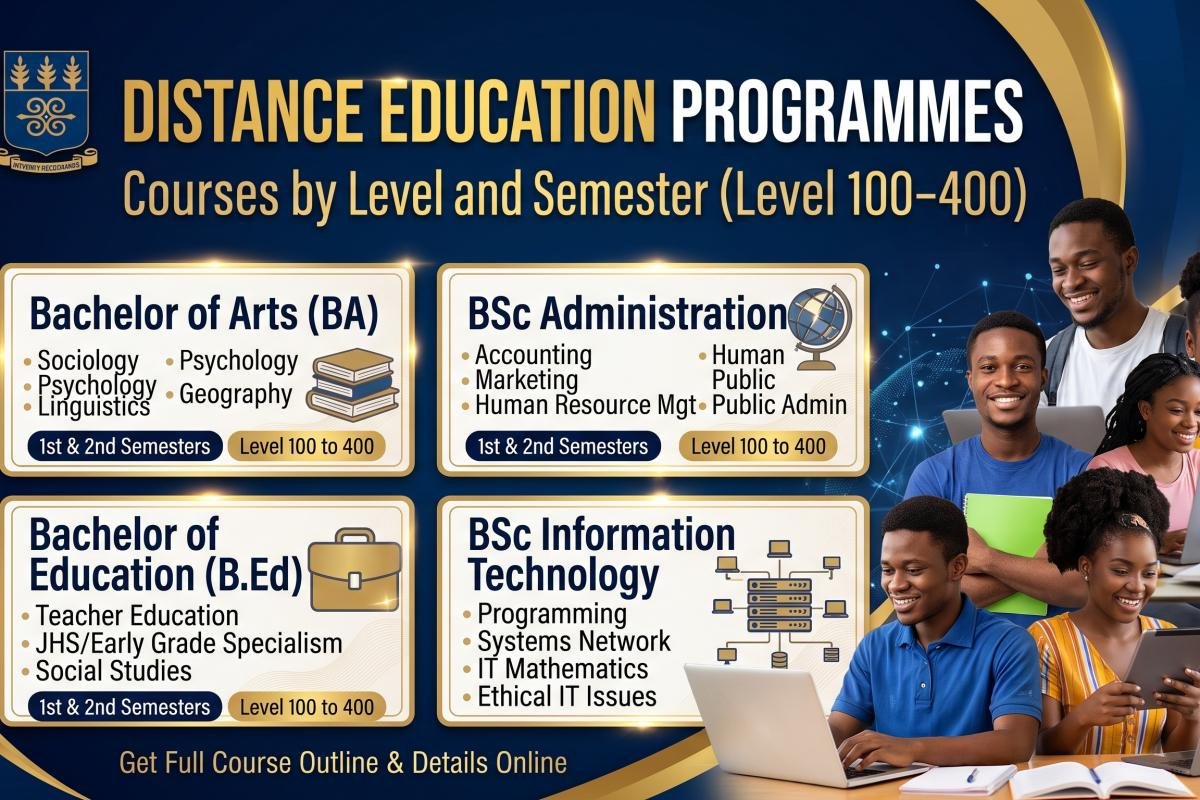
Every University of Ghana Distance Education course for all levels and both semesters, what each subject really demands, what happens with all 13 subject combinations when you drop at Level 200, and the career paths for each.

Every programme, level and semester, what each subject really demands, and what happens with every possible combination when you drop a subject at Level 200.
If you are confused or worried about dropping a subject, you are not alone. Many students reach Level 200 feeling that one wrong click could ruin their degree. It will not, if you understand the rules and decide calmly.
- The four kinds of “dropping”
- Rules that decide your outcome
- Course analysis, subject by subject
- Every combination when you drop
- Bouquet students: your drop choice
- How to decide: scorecard and steps
- Adding and dropping on MIS
- Major, minor or combined at Level 300
- All courses: all levels, both semesters
- Career opportunities
- Mistakes to avoid
- One-on-one help
Where the course lists come from
- First semester: the official First Semester 2026/2027 bulletin.
- Second semester: the revised Second Semester 2025/2026 bulletin, the newest published. It may change when the 2026/2027 one comes out, so check before you register.
- The official bulletin and your own record always come first.
First, what does “dropping” mean?
Students use one word for four different things. Much of the panic comes from mixing them up.
1. Three subjects become two
At Level 200, BA students continue with two of their three Level 100 subjects. Everyone goes through this. It is part of the 3:2:2:1 or 3:2:2:2 degree design, and it does not mean you failed anything.
2. Cancelling a registered course
This is the add and drop on MIS during the registration period. It is a different action, with a time limit. The regulations allow up to 21 days from the start of semester, where applicable.
3. Becoming a major, minor or combined student
At Levels 300 and 400, each department sets a different course load for each path. A minor subject stops before the final year. See the table below.
4. Business School option choice
BSc Administration students choose one option, with departmental approval, by the end of the third semester or the middle of the second year. The same thinking applies.
What happens to the subject you drop?
- Its courses stop, but its Level 100 grades stay.
- All your results from Level 100 count towards your final grade.
- A fail does not vanish because you stopped the subject. If you failed a course in it, ask the DE Office what you must do.
Diploma-to-degree students
- You enter with two subjects, so you do not make this drop.
- The regulations require you to major in, or combine, your diploma subject.
- Your extra University Required Courses (UGRCs) add to your load, and 21 credits is the maximum.
- If adding UGRCs would take you past 21, the bulletin tells you to email the College Academic Officer at coeacademic@ug.edu.gh.
The rules that decide your outcome
These come from the University of Ghana Regulations for Junior Members and the Distance Education bulletins.
| Rule | What it says | What it means for you |
|---|---|---|
| Pass mark |
| A few marks can change a pass to a fail, so be realistic |
| Required courses |
| Never treat these as side courses |
| Good standing | CGPA of at least 1.00, plus any entry conditions for the next level | Check your CGPA on MIS before you decide |
| No probation | Students who do not qualify to progress are asked to withdraw | In October 2026, UG directed undergraduates below 1.00 to withdraw |
| Failed courses |
|
|
| Repeating |
| A repeat costs money and time, and the first fail is not erased |
| Attendance | Missing 25% of prescribed activities means you are treated as withdrawn from the course | You cannot sit that exam |
| Missed exam | A registered student who misses the exam gets grade X, worth 0 | Never leave a course registered and unattended |
| Marks | The exam is normally 70% and continuous assessment 30% | Quizzes and assignments matter |
| Credit load | The DE bulletin sets 21 credits as the maximum | Heavy pairs leave less room for add-ons |
Why later levels matter most
Levels 100, 200, 300 and 400 are weighted 1:1:2:2. Suppose your GPA is 2.0, 2.5, 3.0 and 3.0. Your final grade is (2.0 + 2.5 + 6.0 + 6.0) ÷ 6 = 2.75, a Second Class Lower. So the subjects you keep carry two-thirds of your final grade. That is why it is worth looking ahead before you choose.
 Become a Forever Business Owner
Buy Forever products at a discount, earn retail profit and get team support. Join my team.
See how it works
Advertise here
| Class of degree | FGPA |
|---|---|
| First Class | 3.60–4.00 |
| Second Class Upper | 3.00–3.59 |
| Second Class Lower | 2.00–2.99 |
| Third Class | 1.50–1.99 |
| Pass | 1.00–1.49 |
| Fail | Below 1.00 |
Course analysis: what each subject really demands
Students often ask which subject is easiest. The honest answer is that it depends on you. The University does not publish pass rates by subject in these bulletins, so we will not invent any. What we can do is read the actual course lists from Level 200 to Level 400 and show you what kind of work each subject asks for. Compare that with what you are good at.
| Subject | Maths and statistics | Reading and essays | Theory to learn | Computers | Research | Language practice |
|---|---|---|---|---|---|---|
| Psychology | Medium | Medium | High | Low | Required | Low |
| Sociology | Your choice | High | High | Low | Your choice | Low |
| Political Science | Low | High | High | Low | Core | Low |
| Economics | High | Medium | High | Low | None listed | Low |
| Information Studies | Low | Medium | Medium | High | Your choice | Low |
| Professional Development | Low | Medium | Medium | Low | Your choice | Low |
| Human Resource Development | Low | Medium | Medium | Low | None listed | Low |
| French | Low | Medium | Medium | Low | None listed | High |
These ratings are our reading of the course titles in the bulletins. They are not official and they are not pass rates. A “High” simply means more of that kind of work.
Psychology
- Biological Psychology (PSYC 223) and Experimental Psychology (PSYC 224) arrive at Level 200.
- At Level 300, PSYC 331 Statistics is for all combined students, followed by PSYC 334 Research Methods.
- Level 400 adds Cognitive Psychology II and Practicals in Cognition II.
You remember terms well, you are curious about people, and you can cope with basic statistics.
Think twice if- You keep it only because PSYC 101 and 102 felt easy.
- Level 100 is “Elements” and “Everyday Living”.
- Later courses are more scientific.
- Combined students must do their research in Psychology and may not take a research course in another department.
- So Psychology shapes what you take in your second subject.
Sociology
- Level 200 covers concepts and Ghanaian institutions.
- Level 300 brings Foundations of Social Thought and Social Psychology, with Research Methods (SOCI 325) and Quantitative Methods (SOCI 326) for those who do research here.
You enjoy reading, discussing society and writing long answers in your own words.
Think twice if- You dislike theory.
- Foundations of Social Thought and Perspectives in Social Theory are core for everyone.
- SOCI 321, 323 and 325 are prerequisites for SOCI 322, 324 and 326, and the bulletin says the rule must be strictly followed.
- Failing to complete a first-semester course can block its second-semester partner.
Political Science
- Development, public administration, international and comparative politics at Level 200.
- Political thought and political research at Level 300.
- Applied Political Research (POLI 443) remains core at Level 400.
You follow public life, argue well on paper and like history and ideas.
Think twice if- You want one single subject.
- There is no single major in Political Science, so you will always combine it.
POLI 443 is core at Level 400, so research does not fully go away even if you did research in your other department at Level 300.
Economics
- ECON 213 Mathematics for Economists and ECON 214 Statistics at Level 200.
- Microeconomic and Macroeconomic Theory at Level 300.
- Economic Theory at Level 400.
- Level 200 carries 9 credits per semester, where most subjects carry 6.
You are comfortable with mathematics and graphs, and you scored well in ECON 101 and 102.
Think twice if- Maths worries you, or your time is very tight.
- This is the heaviest Level 200 load in the BA.
- At Level 300 the electives include Applied Mathematics (ECON 315, 316) or Economic Development and Growth (ECON 317, 318).
- Your choice can lower or raise your maths load.
- Level 400 combined students take the core plus two electives.
Information Studies
- Information Technology, Information Management, Management and Computing at Level 200.
- Then Classification, Indexing, System Analysis and Design, Database Management and Records Management.
You like organising information and are willing to practise on a computer.
Think twice if- You have little access to a computer.
- Courses such as INFS 214, 328 and 329 are hard to master from notes alone.
- Combined students take any two core courses and one elective at Level 300.
- If you combine with Psychology, you replace INFS 323 with an elective.
- Think about which core courses suit you best.
Professional Development
- Essential Soft Skills, Adult Education for Professionals and Adult Psychology at Level 200.
- Then Research Methods, Developing New Businesses and Organisational Communication at Level 300.
You work already, or you want to go into training, administration or your own business.
Think twice if- You want a long list of past students to learn from.
- This programme is new and still moving up level by level.
- The bulletins do not yet list its second-semester Level 300 courses or Level 400.
- Our earlier guide expects Level 400 in 2027/2028.
- Confirm with the department.
Human Resource Development
- Contemporary Issues, Principles and Practices of HRD, and Adult Psychology at Level 200.
- Then Resourcing Organisations, Training and Development, and Instructional Designs at Level 300.
You want HR, training or staff development and you like practical, people-centred courses.
Think twice if- You hope to minor lightly.
- Combined students take all three core courses at Level 300.
- Its Level 300 list shows no research course, so ask where your research will be done.
- The second-semester Level 300 list and Level 400 are not published yet.
French
- Grammar, oral skills, reading and writing, translation and literature at Level 200, with 9 credits per semester.
- BA 5 students already carry two French courses at Level 100, which makes 18 credits there.
You already have a good base, and you can practise speaking and listening several times a week.
Think twice if- You chose it hoping to learn from scratch quickly.
- Grammar and oral skills build on each other.
- Important: none of the three bulletins we checked lists French at Level 300 or 400.
- Before you keep French, ask the DE Office in writing how you would continue it.
Which subject can I pass easily?
It is fair to ask this. Passing protects your CGPA, your class of degree and your place in the University. But look for evidence instead of rumours:
- Your own grades are the best evidence. Look at both semesters of Level 100, and ask why you got each grade.
- Match the work to your strengths. If numbers frighten you but you write well, Political Science and Sociology may fit better than Economics. If essays are hard but you learn by doing, look at Information Studies.
- Ask students a level ahead what the exams were like, and treat one person’s fear as opinion, not fact.
- An easy pass is not the only goal. A subject you can pass but cannot use may leave you with a degree you do not know how to sell. Aim for a pair you can pass well and still use.
Every combination: what happens when you drop
Pick your group. Each one shows your three possible outcomes. Then read the full card for each pair you are considering.
Check your record first. The bulletin tells Level 200 students to select the two subjects assigned to them, and the regulations add that departments can set entry requirements. Confirm with your Learning Centre that the pair you want is open to you, especially if a subject has a low grade or fail.
Show my group:
BA 1: POLI, SOCI, INFS
| If you drop | You keep | This may suit you if | Details |
|---|---|---|---|
| INFS | POLI + SOCI | You prefer reading and writing to computers | Read the card |
| SOCI | POLI + INFS | You want public service plus practical information skills | Read the card |
| POLI | SOCI + INFS | You want a flexible pair and can choose how much maths to take | Read the card |
BA 2: ECON, SOCI, PSYC
| If you drop | You keep | This may suit you if | Details |
|---|---|---|---|
| PSYC | ECON + SOCI | You like numbers and want development or policy work | Read the card |
| SOCI | ECON + PSYC | You are strong in numbers and ready for the most statistics | Read the card |
| ECON | SOCI + PSYC | Economics maths is your worry and you want people-centred work | Read the card |
BA 3: PSYC, SOCI, INFS
| If you drop | You keep | This may suit you if | Details |
|---|---|---|---|
| INFS | SOCI + PSYC | You want counselling support, social work or HR | Read the card |
| SOCI | PSYC + INFS | You want HR or administration with computer skills | Read the card |
| PSYC | SOCI + INFS | Psychology’s science side worries you | Read the card |
BA 4: PODE, PSYC, INFS
| If you drop | You keep | This may suit you if | Details |
|---|---|---|---|
| INFS | PODE + PSYC | You want training, HR or learning and development | Read the card |
| PSYC | PODE + INFS | You want few numbers and practical office skills | Read the card |
| PODE | PSYC + INFS | You want departments with a full published course list to Level 400 | Read the card |
BA 5: SOCI, INFS, FREN
| If you drop | You keep | This may suit you if | Details |
|---|---|---|---|
| FREN | SOCI + INFS | French has been hard, or you want a clear path to Level 400 | Read the card |
| INFS | SOCI + FREN | Your French is strong and the DE Office confirms how it continues | Read the card |
| SOCI | INFS + FREN | You like language and computers, and the DE Office confirms the path | Read the card |
BA 6: HRDE, INFS, PODE
| If you drop | You keep | This may suit you if | Details |
|---|---|---|---|
| PODE | HRDE + INFS | You want HR with records and information systems | Read the card |
| INFS | HRDE + PODE | You are sure about people development and want to avoid computing | Read the card |
| HRDE | PODE + INFS | You want a broader office, communications or business mix | Read the card |
The 13 pairs at a glance
| Pair | Level 200 credits per semester | Numbers | Computers | Reading | Course list to Level 400? |
|---|---|---|---|---|---|
| POLI + SOCI | 15 | Low if research is in POLI | Low | High | Yes |
| POLI + INFS | 15 | Low | High | Medium | Yes |
| SOCI + INFS | 15 | Low if research is in INFS | High | Medium | Yes |
| ECON + SOCI | 18 | High | Low | Medium | Yes |
| ECON + PSYC | 18 | Highest | Low | Medium | Yes |
| SOCI + PSYC | 15 | Medium | Low | High | Yes |
| PSYC + INFS | 15 | Medium | High | Medium | Yes |
| PODE + PSYC | 15 | Medium | Low | Medium | PODE not yet |
| PODE + INFS | 15 | Low | High | Medium | PODE not yet |
| SOCI + FREN | 18 | Low | Low | High | FREN: ask first |
| INFS + FREN | 18 | Low | High | Medium | FREN: ask first |
| HRDE + INFS | 15 | Low | High | Medium | HRDE not yet |
| HRDE + PODE | 15 | Low | Low | Medium | Neither yet |
Credits include one University Required Course for continuing students. Diploma-to-degree students carry 3 more, so an 18-credit pair becomes 21, the maximum.
Stuck between two pairs?
Bring your Level 100 results and career goal. In 30 minutes you can go through your options with Isaac and leave with a clear plan.
Book a 30-minute session: GHS 100POLI + SOCI
BA 1, dropping Information StudiesThe essay pair. Expect a lot of reading, theory and written argument, with little computing.
Level 300 research route- Do research in Political Science (POLI 343, 344) and you take SOCI 321, 323 and an elective, then SOCI 322, 324 and an elective, which avoids SOCI 326 Quantitative Methods.
- Or do research in Sociology (SOCI 325, 326) and replace POLI 343 and 344 with electives.
- Do not duplicate research.
- Theory is core in both: Political Thought in POLI and Social Thought in SOCI.
- POLI 443 Applied Political Research stays core at Level 400 either way.
Public service and local government, civil society, policy research, community development, journalism.
POLI + INFS
BA 1, dropping SociologyA mix of ideas and practical skill. You read politics in one department and work with systems and information in the other.
Level 300 research route- The simple route is research in Political Science.
- If you take INFS 323, the bulletin still says students combining with Political Science should do POLI 344 in the second semester.
- So taking research in Information Studies does not free you from POLI 344.
- You switch styles between essay writing and technical work.
- INFS 214, 328 and 329 are easier with regular computer access.
Public sector records and information, parliament and council offices, public relations, administration, policy support.
SOCI + INFS
BA 1, BA 3 or BA 5The most common outcome, since three groups can reach it. A flexible pair of understanding people and managing information.
Level 300 research route- Take INFS 323 and you must not take SOCI 326, which avoids Quantitative Methods.
- Or take SOCI 325, which means all three Sociology core courses in both semesters, and you do not select INFS 323.
SOCI 321 and 323 are strict prerequisites for SOCI 322 and 324, so a poor first semester affects your second.
Where it can leadNGO programme and data work, records and knowledge management, research assistance, public relations, administration.
ECON + SOCI
BA 2, dropping PsychologyEconomics brings the maths, and Sociology brings the reading. It suits development-minded students who can do both.
Level 300 research route- Economics lists no research methods course.
- Ask the department whether you should do SOCI 325 and 326.
- Combined Economics at Level 300 means ECON 311, 313 and one elective each semester.
- Level 200 has 18 credits each semester, or 21 for diploma-to-degree students.
- Only keep this pair if you did well in ECON 101 and 102.
Development planning, monitoring and evaluation, research, NGOs, banks, policy work.
ECON + PSYC
BA 2, dropping SociologyThe most statistical pair: ECON 213 and 214, PSYC 224 and 331, then PSYC 334 Research Methods. Very valuable if you are strong in numbers, and risky if you are not.
Level 300 research route- Research must be in Psychology, and Economics has no research course to clash with.
- Choosing ECON 317 and 318 instead of the Applied Mathematics electives can lower the maths load.
- Two theory-heavy subjects at once.
- Level 400 includes PSYC 449 Practicals in Cognition II.
- Banking, consumer and market research, HR analytics, research, insurance.
- A strong pairing for data roles if you add Excel skills.
SOCI + PSYC
BA 2 or BA 3Two people-centred subjects that often support each other. A natural pair for social and human services.
Level 300 research route- Research must be in Psychology.
- The Sociology guideline is clear: take SOCI 321, 323 and an elective, then SOCI 322, 324 and an elective.
- You do not take SOCI 325 or 326.
- Both list a course called Social Psychology (SOCI 323 and PSYC 443).
- The Sociology department says duplicated courses across social science departments count as one with three credits, so ask how this applies to you.
- Counselling support, social work support, HR, community development, NGOs, gender and child welfare programmes.
- Practising as a psychologist needs further study.
PSYC + INFS
BA 3 or BA 4People plus systems. A practical pair for HR and administration where staff records and data matter.
Level 300 research route- Research must be in Psychology.
- The Information Studies guideline tells you to replace INFS 323 with an elective, so you take INFS 321, 325 and an elective at first semester.
- You carry statistics and computing together.
- Check that your time and computer access allow both.
HR and administration, records management, research assistance, customer experience, training support.
PODE + PSYC
BA 4, dropping Information StudiesWorkplace skills backed by the science of behaviour. A good pair for working adults in training or people roles.
Level 300 research routeResearch must be in Psychology, so at Level 300 you take two PODE core courses and one elective.
Watch out forProfessional Development’s later lists are not published yet, so confirm the courses for the second semester of Level 300 and for Level 400.
Where it can leadLearning and development, training, HR, coaching support, NGO programmes.
PODE + INFS
BA 4 or BA 6The lowest-maths practical pair. Good for office, communication and small business goals.
Level 300 research route- Do research in one department only.
- Take PODE 301 and you do all three PODE core courses, and you do not select INFS 323.
- Or take INFS 323 and you do two PODE core courses and one elective.
- Few numbers does not mean no work.
- You still have computing in INFS, and PODE’s later course lists are not published yet.
Administration, corporate communication, records and information, small business, training support.
SOCI + FREN
BA 5, dropping Information StudiesKeeps your language skill alongside a social science.
Level 300 research route- French has no research course in the lists.
- If you keep this pair, ask where your research will be done.
- Biggest question: no bulletin we checked lists FREN at Level 300 or 400, yet a BA needs two subjects at Level 300.
- Get the path confirmed by the DE Office before you decide.
Translation support, tourism, trade with French-speaking neighbours, international NGOs, customer service, teaching.
INFS + FREN
BA 5, dropping SociologyAn unusual mix of language and practical information skills. It can stand out if you are good at both.
Level 300 research routeYou would take research in Information Studies (INFS 323), since French lists none.
Watch out for- The same question: confirm how French continues beyond Level 200 before you choose.
- This pair also carries 18 credits at Level 200.
Cross-border trade and logistics administration, international office support, records, translation support.
HRDE + INFS
BA 6, dropping Professional DevelopmentHR knowledge plus records and systems skills. Clear career logic for HR offices.
Level 300 research route- HRDE’s Level 300 list has no research course, and combined students take all three core courses.
- INFS 323 is the visible research option, so confirm this with the department.
HRDE’s later lists are not published yet.
Where it can lead- HR officer, HR records and systems, recruitment, training coordination.
- Consider the Institute of Human Resource Management Practitioners, Ghana.
HRDE + PODE
BA 6, dropping Information StudiesVery focused on people development. It is close to one big subject, which is a strength if you are certain and a risk if you are not.
Level 300 research route- If you take PODE 301, you do all three PODE and all three HRDE core courses.
- Ask the department to confirm your route.
- Both departments list a course called Adult Psychology (HRDE 204 and PODE 204).
- Ask how this is treated before you register.
- Neither subject has a published Level 400 list yet, and you give up the computing skills that INFS would add.
- Learning and development, training coordination, HR, staff development.
- Add computer and data skills separately.
BA Bouquet students: your drop choice
In a Bouquet you read a Business School option with Social Science subjects. At Level 100 you take UGBS 101 or 105 plus two subjects. At Level 200 you keep one subject beside your business courses. Your Business School load is fixed, so choose the subject that gives your business courses room to breathe.
| Option | Keep | At Level 300 you take | What to weigh up |
|---|---|---|---|
| Accounting | Psychology |
|
|
| Accounting | Professional Development |
|
|
| Human Resource Management | Psychology |
|
|
| Human Resource Management | Information Studies |
|
|
| Public Administration | Sociology |
|
|
| Public Administration | Information Studies |
| A practical mix for public offices where records and systems matter |
Business Mathematics or Macroeconomics?
- At Level 200, Bouquet students choose UGBS 202 Business Mathematics or UGBS 204 Macroeconomics and Business.
- Pick the one you can do well in, but first check whether your option’s later courses need it.
- Accounting’s later finance courses are worth asking about.
How to decide: career goal or easy pass?
Some students only ask, “Which subject matches my dream job?” Others only ask, “Which is easiest?” Each question alone can lead you wrong. A career subject you keep failing can end in repeats, a low class or withdrawal. An easy subject with no link to your goals can leave you unsure how to use your degree.
The better question: “Which two subjects can I pass well and still use for the life I want?”
A worked example
Imagine Esi, a made-up BA 3 student working in an office, who wants a job in HR. Esi got B+ and B in Psychology, C and C+ in Sociology, and B and B in Information Studies. Statistics makes Esi nervous, but Esi enjoys computers.
| Question | PSYC | SOCI | INFS |
|---|---|---|---|
| Level 100 grades (double) | 3 → 6 | 1 → 2 | 2 → 4 |
| Can handle Levels 200–400 (double) | 1 → 2 | 2 → 4 | 3 → 6 |
| Helps the career goal | 3 | 2 | 2 |
| Enjoyment | 2 | 1 | 3 |
| Fits the other subject | 2 | 2 | 2 |
| Support available | 2 | 1 | 2 |
| Total out of 24 | 17 | 12 | 19 |
Esi’s scorecard points to PSYC + INFS, dropping Sociology. It also shows Esi’s next job: get help with PSYC 331 Statistics early. The score does not make the decision. It makes the decision clear.
Seven steps to decide calmly
Get your facts. Open your results and CGPA on MIS, and note any E, F or X.
Check your assigned options. Confirm what your record allows.
Read ahead. Look at your subjects through Level 400 in the course lists, not just next semester.
Fill in the scorecard for all three subjects, then read the cards for your top pairs.
Test your career plan. Look at real adverts on our jobs board. Check whether your goal needs a licence or further study.
Ask the right people. Your Learning Centre, the Student Support Unit (DE Office on Main Campus), a lecturer and students a level ahead.
Decide and register early. Save a screenshot of your registration, and check it again before the add and drop period ends.
Common situations
| Your situation | A sensible way to think about it |
|---|---|
| You love a subject but got D or E in it |
|
| You passed one subject well but it bores you |
|
| Family wants a subject you do not want |
|
| You want HR, administration or management |
|
| You failed one of your three subjects |
|
| Your CGPA is close to 1.00 |
|
| You work full time |
|
| You want a subject you only took as a HERC |
|
Myths that cause panic
“Dropping means I failed.”
No. Every BA student moves from three subjects to two.
“My dropped subject disappears.”
No. Its Level 100 grades stay in your record and your final grade.
“I must keep the subject with the best job title.”
No. Many careers accept several subjects, and a weak grade in the “right” subject can hurt you more than a strong grade in a related one.
“My degree name decides my whole life.”
Not in most fields. Employers also look at your class of degree, experience and skills. Licensed fields such as accounting, teaching and clinical psychology are the main exceptions.
Adding and dropping courses on MIS
A University of Ghana college guide describes the process like this. Your screens may differ, so confirm with your Learning Centre.
To add
Log in to your MIS page and choose “Add subjects to a registration”.
To drop
Log in to your MIS page and choose “cancel a subject”. That guide warns that you cannot re-register a course you have dropped, so be sure first.
Watch the date. The regulations allow up to 21 days from the start of semester, where applicable. See the 2026/2027 academic calendar, and do not wait for the last day.
After Level 200: major, minor or combined
The regulations describe a major and minor as 3:2:2:1 and a combined major as 3:2:2:2. A major is at least 50% of your credits, and each combined subject is 30–40%. Each department then sets its own load. These are the current guidelines from the bulletins.
| Subject | Combined at Level 300 | Minor at Level 300 | Single major? | Combined at Level 400 |
|---|---|---|---|---|
| Psychology |
|
| Not shown |
|
| Sociology |
|
| Yes: all core + one elective | All three core, both semesters |
| Political Science | Two core + one elective, or an elective in place of research | One core + one elective | No | Two core + one elective |
| Economics | All core + one elective | Both core courses | Not shown | ECON 441 or 442 + two electives |
| Information Studies | Any two core + one elective |
| Yes: all core + an elective |
|
| Professional Development | Two core + elective, or all three with PODE 301 | Two core | Yes: three core + one elective | Not yet listed |
| Human Resource Development | All three core | Two core | Yes: three core + one elective | Not yet listed |
| Adult Education (older list) | All core, or an elective in place of research |
| Not shown |
|
Long essays
- Information Studies single majors may write one with consent from the DE Head of Department.
- Sociology majors do not write one unless approved through the Head of Distance Education.
- Business School long essays also need approval, and they start in the first semester.
All courses: every level, both semesters
Tap a programme to open it. Every course is 3 credits unless the list says otherwise. First-semester lists are from the 2026/2027 bulletin and second-semester lists from the revised 2025/2026 bulletin, except where a note says something else.
University Required Courses (UGRC)
| Who | First semester | Second semester |
|---|---|---|
| Level 100, all programmes | UGRC 150 Critical Thinking and Practical Reasoning | UGRC 110 Academic Writing I |
| Level 200 continuing | UGRC 210 Academic Writing II | One of UGRC 228, 229, 231 |
| Level 200 diploma-to-degree |
| UGRC 210 and one of UGRC 228, 229, 231 |
| Admitted at Level 300 | UGRC 150 | UGRC 110 |
| Level 400, admitted at Level 300 | UGRC 210 | One of UGRC 228, 229, 231 |
| BSc IT | CBAS 210 Academic Writing II replaces UGRC 210 | As shown in the BSc IT list |
Introduction to African Studies: UGRC 228 Chieftaincy and Development, UGRC 229 Culture and Development, UGRC 231 Gender and Development.
Needed to graduate (2020/2021 onward): BA and BSc Administration: UGRC 110, UGRC 150, a Level 100 HERC, UGRC 210 and one of UGRC 228–231. BSc IT: UGRC 110, UGRC 150, CBAS 210 and one of UGRC 228–231.
BA Level 100: groups, subjects and HERCs
Take your three assigned subjects, one HERC from a different department, and your UGRC. A HERC (Humanity and Education Required Course) must be passed with D or better. Your own assigned subjects on your record come first.
| Group | First: assigned | First: HERC options | Second: assigned | Second: HERC options |
|---|---|---|---|---|
| BA 1 | POLI 111, SOCI 121, INFS 111 | PODE 101, PSYC 101, ECON 101, KISW 103 + 105, UGBS 101, UGBS 105 | POLI 112, SOCI 122, INFS 112 | PODE 102, PSYC 102, ECON 102, TEJS 102, PESS 102, UGBS 102, UGBS 104 |
| BA 2 | ECON 101, SOCI 121, PSYC 101 | PODE 101, POLI 111, INFS 111, KISW 103 + 105, UGBS 101, UGBS 105 | ECON 102, SOCI 122, PSYC 102 | PODE 102, POLI 112, INFS 112, TEJS 102, PESS 102, UGBS 102, UGBS 104 |
| BA 3 | PSYC 101, SOCI 121, INFS 111 | PODE 101, POLI 111, ECON 101, KISW 103 + 105, UGBS 101, UGBS 105 | PSYC 102, SOCI 122, INFS 112 | PODE 102, POLI 112, ECON 102, TEJS 102, PESS 102, UGBS 102, UGBS 104 |
| BA 4 | PODE 101, PSYC 101, INFS 111 | POLI 111, ECON 101, SOCI 121, KISW 103 + 105, UGBS 101, UGBS 105 | PODE 102, PSYC 102, INFS 112 | POLI 112, ECON 102, SOCI 122, TEJS 102, PESS 102, UGBS 102, UGBS 104 |
| BA 5 | SOCI 121, INFS 111, FREN 101, FREN 103 | POLI 111, ECON 101, PSYC 101, PODE 101, KISW 103 + 105, UGBS 101, UGBS 105 | SOCI 122, INFS 112, FREN 102, FREN 104 | POLI 112, ECON 102, PSYC 102, PODE 102, TEJS 102, PESS 102, UGBS 102, UGBS 104 |
| BA 6 | HRDE 101, INFS 111, PODE 101 | ECON 101, PSYC 101, POLI 111, SOCI 121, KISW 103 + 105, UGBS 101, UGBS 105 | HRDE 102, INFS 112, PODE 102 | POLI 112, ECON 102, SOCI 122, PSYC 102, TEJS 102, PESS 102, UGBS 102, UGBS 104 |
| Level | First semester | Second semester |
|---|---|---|
| ECON |
|
|
| HRDE |
|
|
| INFS |
|
|
| PODE |
|
|
| POLI |
|
|
| PSYC |
|
|
| SOCI |
|
|
| FREN |
|
|
| HERCs |
|
|
Psychology (PSYC): Levels 200–400
| Level | First semester | Second semester |
|---|---|---|
| 200 |
|
|
| 300 |
|
|
| 400 |
|
|
Sociology (SOCI): Levels 200–400
| Level | First semester | Second semester |
|---|---|---|
| 200 |
|
|
| 300 |
|
|
| 400 |
|
|
Political Science (POLI): Levels 200–400
| Level | First semester | Second semester |
|---|---|---|
| 200 |
|
|
| 300 |
|
|
| 400 |
|
|
Economics (ECON): Levels 200–400
| Level | First semester | Second semester |
|---|---|---|
| 200 |
|
|
| 300 |
|
|
| 400 |
|
|
Information Studies (INFS): Levels 200–400
| Level | First semester | Second semester |
|---|---|---|
| 200 |
|
|
| 300 |
|
|
| 400 |
|
|
Professional Development (PODE): Levels 200–300
| Level | First semester | Second semester |
|---|---|---|
| 200 |
|
|
| 300 |
| Not in the published bulletins yet. |
This programme is rolling out level by level. Level 400 is expected in 2027/2028.
Human Resource Development (HRDE): Levels 200–300
| Level | First semester | Second semester |
|---|---|---|
| 200 |
|
|
| 300 |
| Not in the published bulletins yet. |
French (FREN): Level 200
| Level | First semester | Second semester |
|---|---|---|
| 200 |
|
|
The bulletins we checked do not list French at Level 300 or 400. Ask the DE Office.
Adult Education (ADLT): Levels 300–400
| Level | First semester | Second semester |
|---|---|---|
| 300 |
|
|
| 400 |
|
|
The 2026/2027 first-semester bulletin lists Adult Education at Level 400 only, with Professional Development and Human Resource Development now at Level 300.
BA Bouquets: Levels 100–400
| Level | First semester | Second semester |
|---|---|---|
| 100 all |
|
|
| 200 all |
|
|
| 300 Acct |
|
|
| 300 HRM |
|
|
| 300 PADM |
|
|
| 400 Acct |
|
|
| 400 HRM |
|
|
| 400 PADM |
|
|
BSc Administration: Levels 100–200 (all students)
| Level | First semester | Second semester |
|---|---|---|
| 100 |
|
|
| 200 |
|
|
Students admitted at Level 300 add UGRC 150 in the first semester and UGRC 110 in the second. In Level 400 they add UGRC 210.
BSc Administration: Accounting
| Level | First semester | Second semester |
|---|---|---|
| 300 |
|
|
| 400 |
|
|
BSc Administration: Banking and Finance
| Level | First semester | Second semester |
|---|---|---|
| 300 |
|
|
| 400 |
|
|
BSc Administration: Human Resource Management
| Level | First semester | Second semester |
|---|---|---|
| 300 |
|
|
| 400 |
|
|
BSc Administration: Marketing
| Level | First semester | Second semester |
|---|---|---|
| 300 |
|
|
| 400 |
|
|
BSc Administration: Public Administration
| Level | First semester | Second semester |
|---|---|---|
| 300 |
|
|
| 400 |
|
|
BSc Administration: Health Services Administration
| Level | First semester | Second semester |
|---|---|---|
| 300 |
|
|
| 400 |
|
|
B.Ed Early Grade
| Level | First semester | Second semester |
|---|---|---|
| 100 |
|
|
| 200 |
|
|
| 300 |
|
|
The bulletins we checked do not list B.Ed Level 400. Confirm with your department.
B.Ed Upper Primary
| Level | First semester | Second semester |
|---|---|---|
| 100 |
|
|
| 200 |
|
|
| 300 |
|
|
The first-semester Level 200 list also shows UGTE 201 Ghanaian Identity, Culture and Arts, so confirm your exact list. The bulletins we checked do not list Level 400.
B.Ed Junior High School
| Level | First semester | Second semester |
|---|---|---|
| 100 |
|
|
| 200 core |
|
|
| 200 ICT |
|
|
| 200 English |
|
|
| 200 Science |
|
|
| 200 Maths |
|
|
| 200 Social |
|
|
| 300 core |
|
|
| 300 ICT |
|
|
| 300 English |
|
|
| 300 Science |
|
|
| 300 Maths |
|
|
| 300 Social |
|
|
Level 200 is 18 credits per semester. Level 300 is 18 credits per semester. The bulletins we checked do not list Level 400.
BSc Information Technology
| Level | First semester | Second semester |
|---|---|---|
| 100 |
|
|
| 200 |
|
|
| 300 |
|
|
| 400 |
|
|
Career opportunities by subject
These are common paths in Ghana. They are not guarantees, and your skills and experience also count. Where a licence or further study applies, we say so. Confirm requirements with the professional body before you plan around them.
| Subject or option | Where it can lead | Good to know |
|---|---|---|
| Psychology | HR assistant, counselling support, NGO programme work, research assistant, training, sales and customer experience | Practising as a psychologist usually needs postgraduate study and registration with the Ghana Psychology Council |
| Sociology | Social work support, community development, NGOs, research and data collection, gender and policy programmes, HR | Pairs well with research and data skills |
| Political Science | Public service, local government, policy research, civil society, international organisations, journalism, advocacy | Many roles value further study and writing samples |
| Economics | Banks, insurance, research, planning, statistics, policy and development work | Strong with Excel and data tools |
| Information Studies | Records and information management, libraries, archives, public relations, data and knowledge management, administration | Add digital skills to widen your options |
| Professional Development | Learning and development, workplace training, coaching support, administration, small business | A newer programme, so show your skills with projects |
| Human Resource Development | HR officer, recruitment, training coordinator, staff development | Consider the Institute of Human Resource Management Practitioners, Ghana |
| Adult Education | Adult and community education, programme monitoring and evaluation, training | Monitoring and evaluation is a useful skill for NGOs |
| French | Translation support, tourism, international trade, customer service, teaching | Ghana’s French-speaking neighbours make this useful in cross-border trade |
| Accounting | Accounts officer, audit assistant, tax, financial reporting | Consider a professional qualification such as ICAG or ACCA |
| Banking and Finance | Banks, microfinance, credit, investment, insurance | Chartered Institute of Bankers Ghana qualifications are widely known |
| Human Resource Management | HR officer, employee relations, payroll support, recruitment | Labour Law and Manpower Planning are directly useful |
| Marketing | Sales, brand, digital marketing, market research, retail | A small portfolio of your work helps |
| Public Administration | Civil and local government service, NGOs, projects, policy support | Good for those already in public service |
| Health Services Administration | Hospital administration, health records, supply chain, NGOs and health projects | An administration role, not a clinical one |
| Bachelor of Education | Classroom teaching, school leadership, curriculum and education support | Teachers in Ghana need a National Teaching Council licence |
| Information Technology | Software development, support, networking, databases, cyber security, web design | Projects and certifications often count as much as grades |
Whatever you choose, build skills alongside your degree. Read why good grades alone will not guarantee career success and the 7 skills every student should learn before graduation. When you are ready to apply, use our CV Builder and browse the jobs board.
Short self-paced certificates can also strengthen your CV while you study, at GH₵250 each: Emotional Intelligence for Career Growth, Assertive Leadership, Strategic Leadership for Executives and Anger Management for Professionals.
Mistakes to avoid when registering
- Duplicating research courses. Several departments tell you to do research in one department only.
- Skipping prerequisites. The bulletin says to make sure you have satisfied them for all courses.
- Going over 21 credits. Diploma-to-degree students who need more should email coeacademic@ug.edu.gh.
- Forgetting a UGRC. You must pass these with a D or better, and you will not graduate if you fail to sit the exam.
- Staying registered in a course you stopped attending. A missed exam means grade X, worth 0.
- Taking a HERC from your own department. The bulletin asks you to select it from a different department.
- Deciding from fear. Use your results and the scorecard, not rumours.
Need personal help choosing?
A guide can only take you so far, because your results, job, family situation and goals are your own. If you are still unsure, book a one-on-one consultation with Isaac Mintah.
What you get
In 30 minutes, you go through your results, subject options and career goals, and leave with a clear plan.
Details
- Cost: GHS 100 for 30 minutes
- How: online or by phone
- Bring: your Level 100 results, your CGPA and the career you have in mind
Make this decision with someone beside you.
Use the booking form to choose a time and pay for your session.
Book a 30-minute session: GHS 100This consultation is independent advice to help you think clearly. Official decisions on your registration are made by the University, so also speak to your Learning Centre or the Student Support Unit.
Frequently asked questions
Which subject should I drop at Level 200?
There is no single right answer. Compare your Level 100 grades, what the subject demands up to Level 400, your career goal and the support you have. Keep the two subjects you can pass well and still use for your goals.
Do my dropped subject’s grades still count?
Yes. All results from Level 100 count in your final grade point average, so grades from your dropped subject remain on your record.
Which BA subject is the easiest to pass?
It depends on your strengths, and the bulletins do not give pass rates. Economics has the most mathematics, Psychology has required statistics and research, Sociology and Political Science have heavy reading, and Information Studies has more computing. Your own Level 100 grades are the best guide.
Where do I do research methods if I combine two subjects?
In one department only, because you must not duplicate research courses. If you combine with Psychology, research must be in Psychology. Other pairs have a choice, so check the rules for your pair in the guide above.
Can I continue French to Level 400?
The Distance Education bulletins we checked list French at Levels 100 and 200 only. Ask the DE Office in writing how French would continue before you choose to keep it.
How long do I have to add or drop courses?
University of Ghana regulations allow up to 3 weeks (21 days) from the start of semester, where applicable. Confirm this semester’s dates with the academic calendar and your Learning Centre.
What CGPA do I need to continue?
At least 1.00, plus any entry requirements for your subjects at the next level. The regulations have no probation, and students who do not qualify are asked to withdraw.
What if I fail a course?
You can repeat a failed course for a fee. Your transcript shows every attempt, and repeats are averaged into your final grade. Limits on failed credits also apply for graduation.
Should I choose my career subject or the one I can pass?
Consider both. A career subject you keep failing can damage your degree, while an easy subject with no link to your goals may not help you later. Aim for the subjects you can pass well and use.
Are the second-semester courses final?
Not yet. This guide uses the revised 2025/2026 second-semester bulletin until the 2026/2027 one is released, so confirm your courses then.
How do I get personal help with my course choices?
Book a 30-minute consultation with Isaac Mintah for GHS 100 using the booking form on this site. Also speak to your Learning Centre or the Student Support Unit for official registration matters.
Sources
Official Department of Distance Education bulletins: First Semester 2026/2027, Revised Second Semester 2025/2026 and First Semester 2025/2026; our 2025/2026 course guide; University of Ghana Regulations for Junior Members (2017); and the UG College of Humanities academic FAQ. The subject ratings, pair analysis and suggestions are our own reading of these documents. Rules and courses can change, so always confirm with the current bulletin, the student portal or your Learning Centre.

Build a powerful professional brand with Isaac Mintah. Strategic LinkedIn optimisation, personal identity development, and reputation building for ambitious pro...


 Professional Branding for Students
Live webinar, Fri 4 Dec: build a CV, LinkedIn and personal brand employers notice. GH₵50.
Register now
Advertise here

About the Author
Isaac Mintah
Entrepreneur, Author & Emotional Intelligence Coach. Founder of Activezoon Universal Limited Company.
Follow on WhatsApp ChannelGrab a Copy
Emotional Intelligence For Career Growth
Isaac Mintah's flagship book — get your copy now from Amazon or Jumia Ghana.
Leave a comment
Your email address will not be published. Required fields are marked *